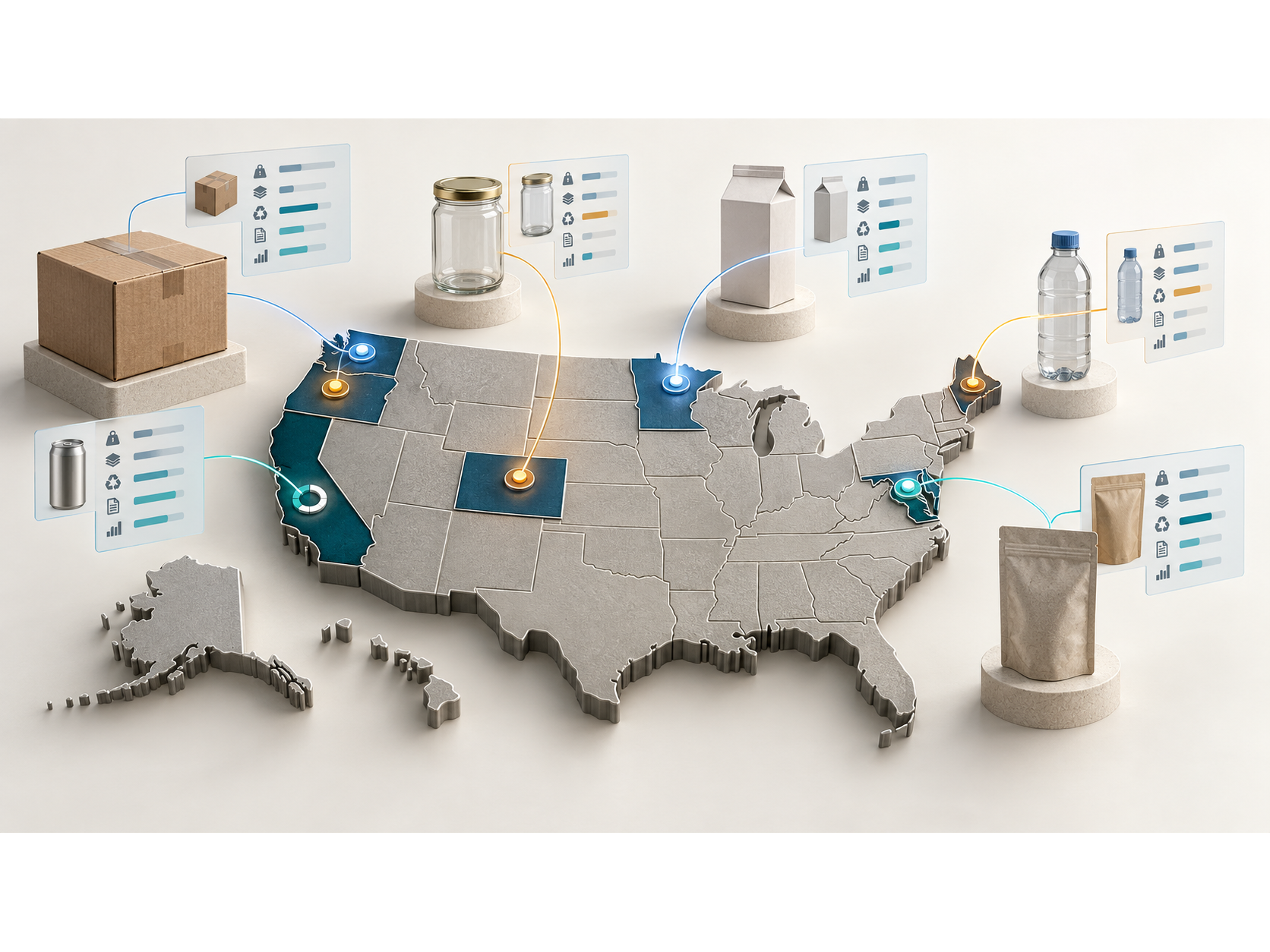
Sustainable packaging is packaging designed to reduce environmental impact across its full life, from material sourcing through manufacturing, transport, use, and end of life. No U.S. law defines the term, which is why it appears on packages that have almost nothing in common.
What is defined, and increasingly enforced, are the specific claims underneath it: recyclable, compostable, and recycled content. Those three have thresholds, test methods, and penalties attached. That gap between the umbrella word and the enforceable claims is where most packaging projects go wrong. A brand picks a material that sounds sustainable, prints a word on the panel that describes it, and finds out later that the word was where the liability sat.
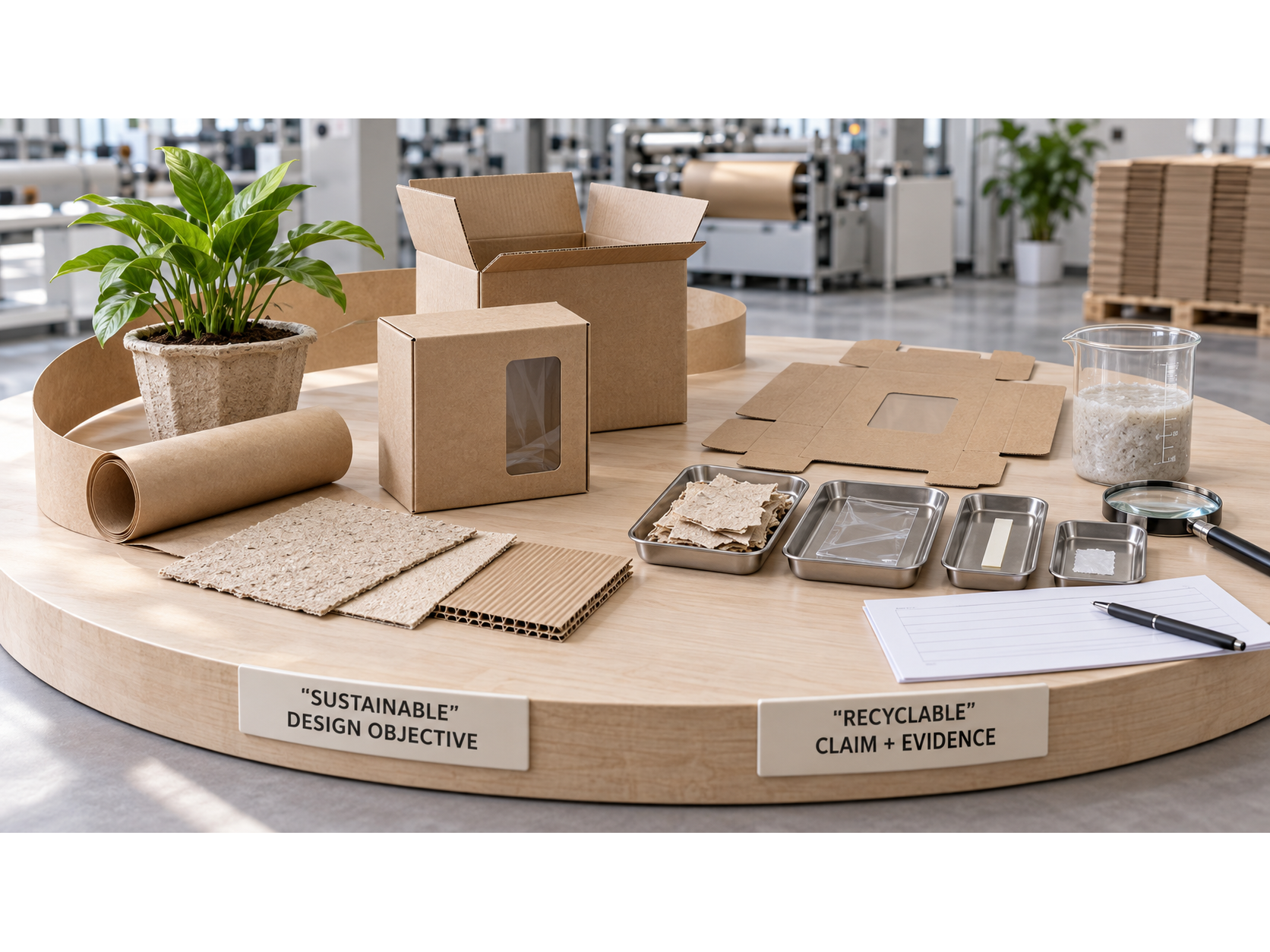
Why "Sustainable" Has No Definition and "Recyclable" Does
The Federal Trade Commission's Green Guides govern environmental marketing claims in the United States. They were last revised in 2012, and the FTC opened a review in December 2022 that has not produced a final update. Revisions remain pending while states move ahead on labeling rules of their own.
The Green Guides deliberately leave "sustainable" alone. When the 2012 revision was finalized, the FTC declined to issue guidance on "sustainable," "natural," and "organic," while addressing what makes a recyclability claim appropriate. A term that broad cannot be substantiated, and the Guides require competent and reliable evidence behind any claim.
What the Guides do define is the threshold for an unqualified recyclable claim. Under 16 CFR Part 260, "substantial majority" in the recyclability context means at least 60 percent. If recycling facilities are available to fewer than 60 percent of consumers where the product is sold, the claim needs a qualifier.
So "sustainable packaging" works as a design objective. "Recyclable," "compostable," and "30% post-consumer recycled" are regulated statements that need documentation behind them before they go on a panel.
The Materials and What Each One Actually Does
Every material is good at something and bad at something else. The question is which trade you can live with.
Material | Typical strengths | Where it fails | Recovery reality |
|---|---|---|---|
Corrugated board | Protection, stacking strength, printability, established recovery | Bulky in transit, poor moisture and grease resistance without coating | Highest recovery rate in U.S. packaging |
Folding carton (SBS, CRB, CUK, FBB) | Print quality, shelf presence, ships flat | Limited barrier, needs a coating or liner for food contact | Recovered with paper where clean and uncoated |
Mono-material PE or PP pouch | Low material weight, low freight volume, one recycling stream | Barrier is harder to achieve than in a mixed laminate | Store drop-off or municipal drop-off, rarely curbside |
Mixed laminate with foil or metallized layer | Best barrier performance available | Multiple polymer families make it effectively unrecyclable | Landfill in nearly all U.S. programs |
PCR content | Reduces virgin material demand, satisfies state mandates | Shorter fibers or polymer chains mean lower strength; food contact needs separate clearance | Depends entirely on the base material |
Certified compostable (PLA, PHA, coated fiber) | Diverts organics where facilities exist | Requires industrial conditions; contaminates recycling if mis-sorted | Access is the limiting factor, not the material |
The pattern across that table is that barrier performance and recyclability pull against each other. Paper on its own resists nothing. It absorbs grease, wicks water, and cannot be heat sealed. Every one of those functions comes from something added to it, and most of the additions are what take the package out of the paper stream.
A mono-material pouch resolves that tension by keeping every layer in one polymer family, with the barrier coming from a metallized layer of that same polymer rather than from foil or a different plastic. It costs some barrier performance against the best mixed laminate, and it buys back the ability to make a recyclability claim.
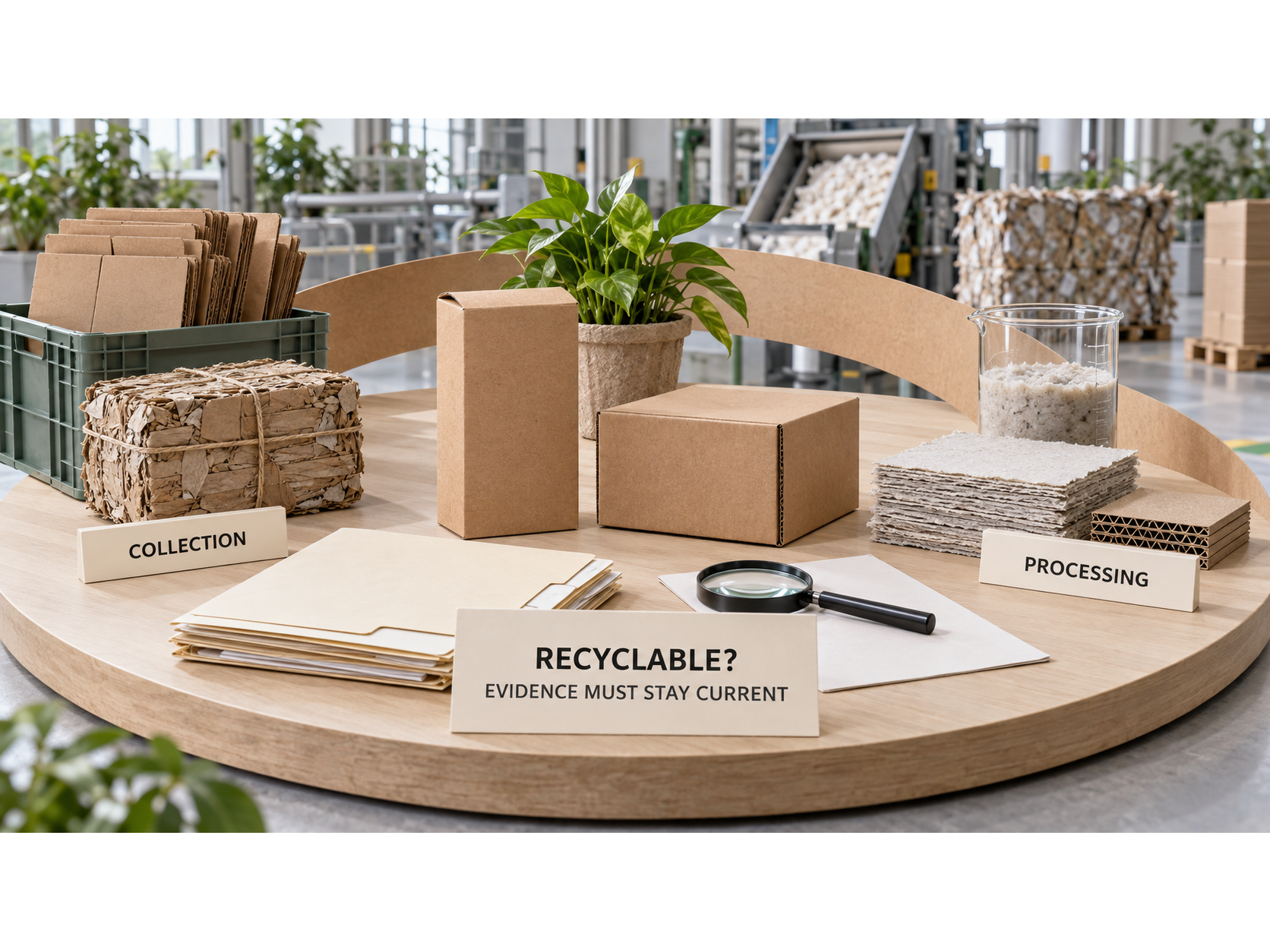
Recyclable Is the Highest-Risk Claim on Your Package
Recyclability is the claim most brands print and the one with the least margin for error, because state law now defines it rather than whether the material can theoretically be recycled.
California SB 343 restricts the chasing arrows symbol and any implied recyclability claim to materials meeting statewide criteria. Those criteria include a 60 percent collection threshold and a 60 percent processing threshold, commonly called the 60/60 requirement, and the burden sits with the manufacturer to determine whether a product qualifies and to keep records supporting the claim.
The timing runs off the manufacturing date rather than the sale date. CalRecycle published its Material Characterization Study Final Findings on April 4, 2025, and the labeling restrictions apply to products and packaging manufactured after October 4, 2026, which is 18 months later. Anything manufactured before that date is exempt regardless of when it sells.
This is a recurring obligation. CalRecycle will publish a second characterization study in 2027 and additional findings every five years after that, and each new study starts another 18-month window to update labels against revised findings. A material that qualifies today can stop qualifying when infrastructure shifts.
One complication worth tracking: a federal court granted a preliminary injunction on July 14, 2026, pausing California Attorney General enforcement of SB 343, though the October 4, 2026 date and other enforcement paths remain relevant. Companies not party to the litigation still carry enforcement risk.
What Recyclability Looks Like in the Recovery Data
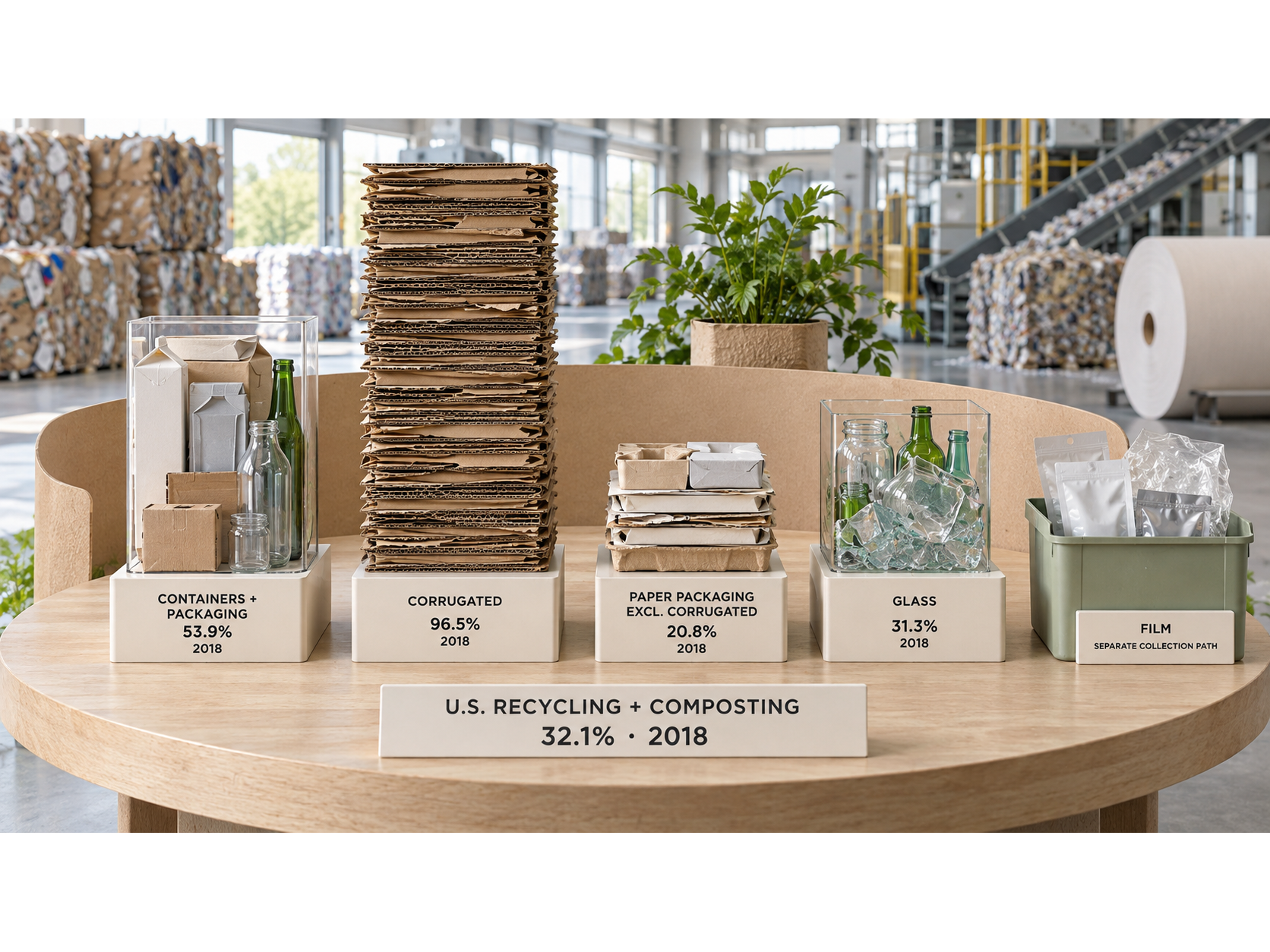
The most recent national figures from EPA are worth reading before designing around a recyclability claim. In 2018, containers and packaging had a recycling rate of 53.9 percent overall. That number hides an enormous spread. Corrugated boxes recycled at 96.5 percent, while paper containers and packaging excluding corrugated recycled at 20.8 percent. Glass containers recycled at 31.3 percent.
For the system as a whole, total U.S. municipal solid waste recycling and composting was 32.1 percent in 2018, and EPA's own infrastructure assessment estimates that adequate investment could raise the national rate from 32 percent to 61 percent, clearing the agency's goal of 50 percent by 2030.
Two things follow. Corrugated is genuinely, verifiably recycled, which makes it the safest substrate for a recyclability claim. And the 2018 vintage of the data is itself a problem, since EPA has not published newer national figures and the most authoritative U.S. recovery numbers now trail the infrastructure they describe.
Pouches and films sit outside all of this. They are not collected curbside in most U.S. programs, which puts them outside an unqualified recyclable claim almost everywhere, and the recovery pathway is drop-off. That pathway is broader than most brands assume: research presented at SPC Impact 2026 found that 92 percent of Americans live within 10 miles of a film collection site and 73 percent of consumers recognize store drop-off as a recycling option.
How2Recycle and the Sustainable Packaging Coalition are updating film labels to cover municipal drop-off, mail-back, and subscription services alongside store collection, with the word "return" tested as the clearest instruction because film requires an action beyond the curbside bin. The refreshed Store Drop-off label dropped arrows-in-a-circle from its symbology out of caution around what SB 343 will treat as a recyclability claim. A symbol that implies recyclability gets treated as a claim, whether or not the word appears.
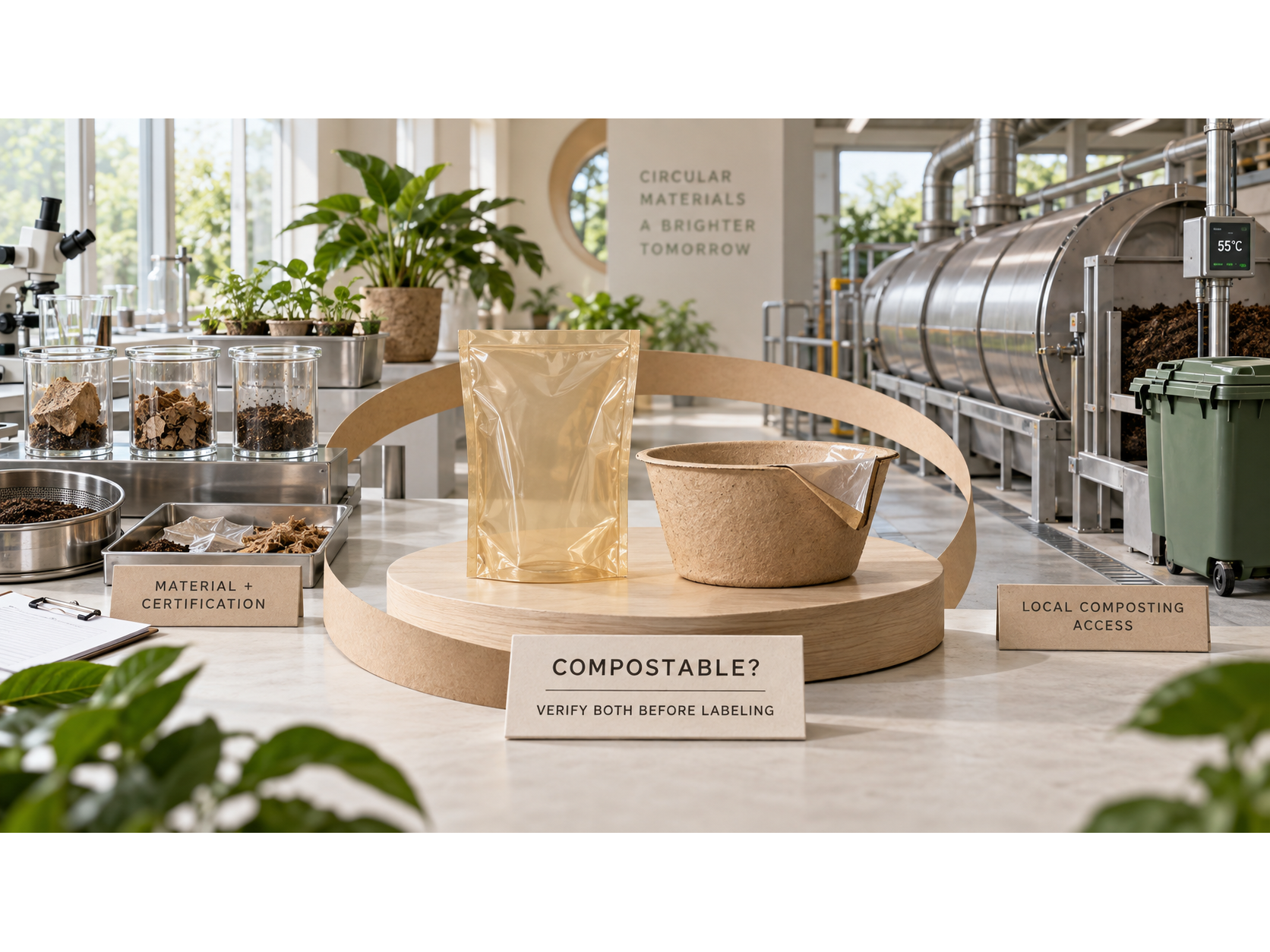
Compostable: Certification Proves the Material, Access Decides the Label
ASTM D6400 is the U.S. standard for plastics designed to compost in municipal or industrial facilities. To meet it, a material must achieve at least 90 percent conversion of organic carbon to CO₂ within 180 days, at least 90 percent disintegration through a 2mm sieve after 84 days, no negative effect on plant growth in the resulting compost, and heavy metals below specified thresholds.
ASTM D6868 covers a different construction. D6400 applies to single-material plastics and resins, while D6868 covers a film or coating laminated onto paper or fiber, where every layer has to independently pass D6400. A paper bowl with a bioplastic lining is a D6868 product.
The conditions those standards assume do not exist in a backyard bin. Industrial composting maintains sustained temperatures of 50°C to 60°C with managed moisture and aeration, while home compost systems rarely exceed 35°C to 40°C or hold a consistent temperature over weeks.
State rules now set the wording as well as the standard. Minnesota requires that as of January 1, 2026, bags, packaging, and food service products labeled compostable be certified by a qualifying third party, and BPI is currently the only certifier meeting the law's requirements. Washington requires a third-party certifier logo, the word "compostable" where possible, and a color signal: the product tinted green, beige, or brown, or at minimum a stripe of that color at least 0.25 inch wide. California requires D6400 for compostable plastics and D6868 for plastic-coated fiber, sets total organic fluorine below 100 ppm, and prohibits the chasing arrows symbol on compostable plastic bags.
Holding a D6400 or D6868 certificate is the substantiation step. FTC 16 CFR §260.7 and state law decide what can actually be printed, and a label compliant in one state may not be compliant in another.
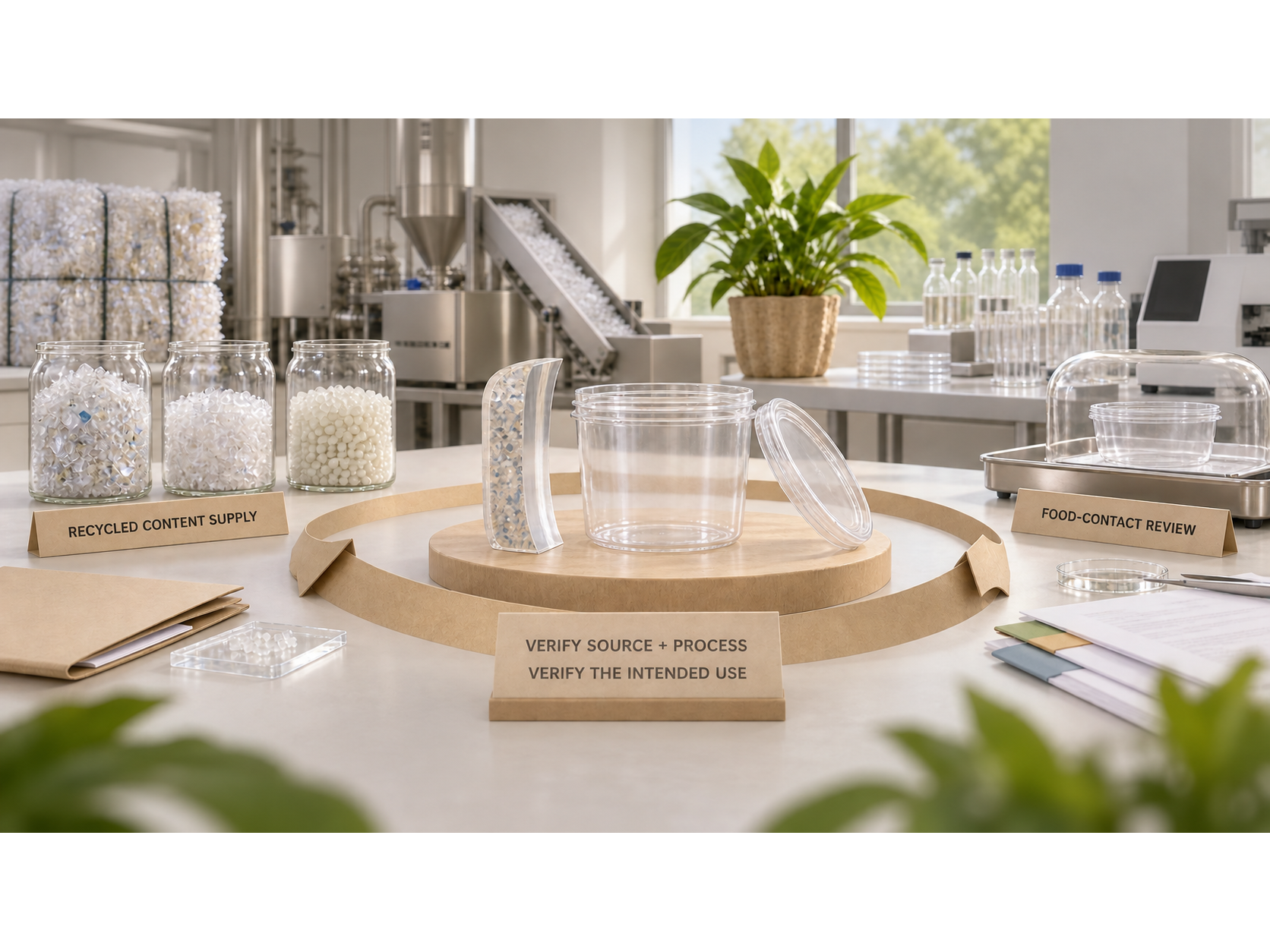
Recycled Content Is a Supply Question and a Food Safety Question
Recycled content is the one sustainability attribute becoming mandatory rather than optional. California, Washington, New Jersey, Maine, and Connecticut have enacted laws requiring post-consumer recycled content in plastic packaging, with targets escalating toward 50 percent for beverage containers in several states by the early 2030s and multiple states carrying annual reporting obligations. California's SB 1053 also requires recycled paper bags sold at checkout to carry at least 40 percent post-consumer content, rising to 50 percent by 2028.
For anything touching food there is a second gate. FDA evaluates each proposed use of recycled plastic case by case and issues informal advice on whether a recycling process is expected to produce PCR of suitable purity for food-contact applications, resulting in a no objection letter on the suitability of a specific process. For secondary and tertiary recycling, the manufacturer must demonstrate that contaminants from prior use are sufficiently removed.
The detail that matters when sourcing is that a no objection letter is process-specific and use-specific, tied to the polymer, the feedstock source and controls, the recycling process, the intended food type, conditions of use, and any limits on recycled content, contact layer, or multilayer structure. A supplier holding an NOL and your specific application being covered by it are two different things.
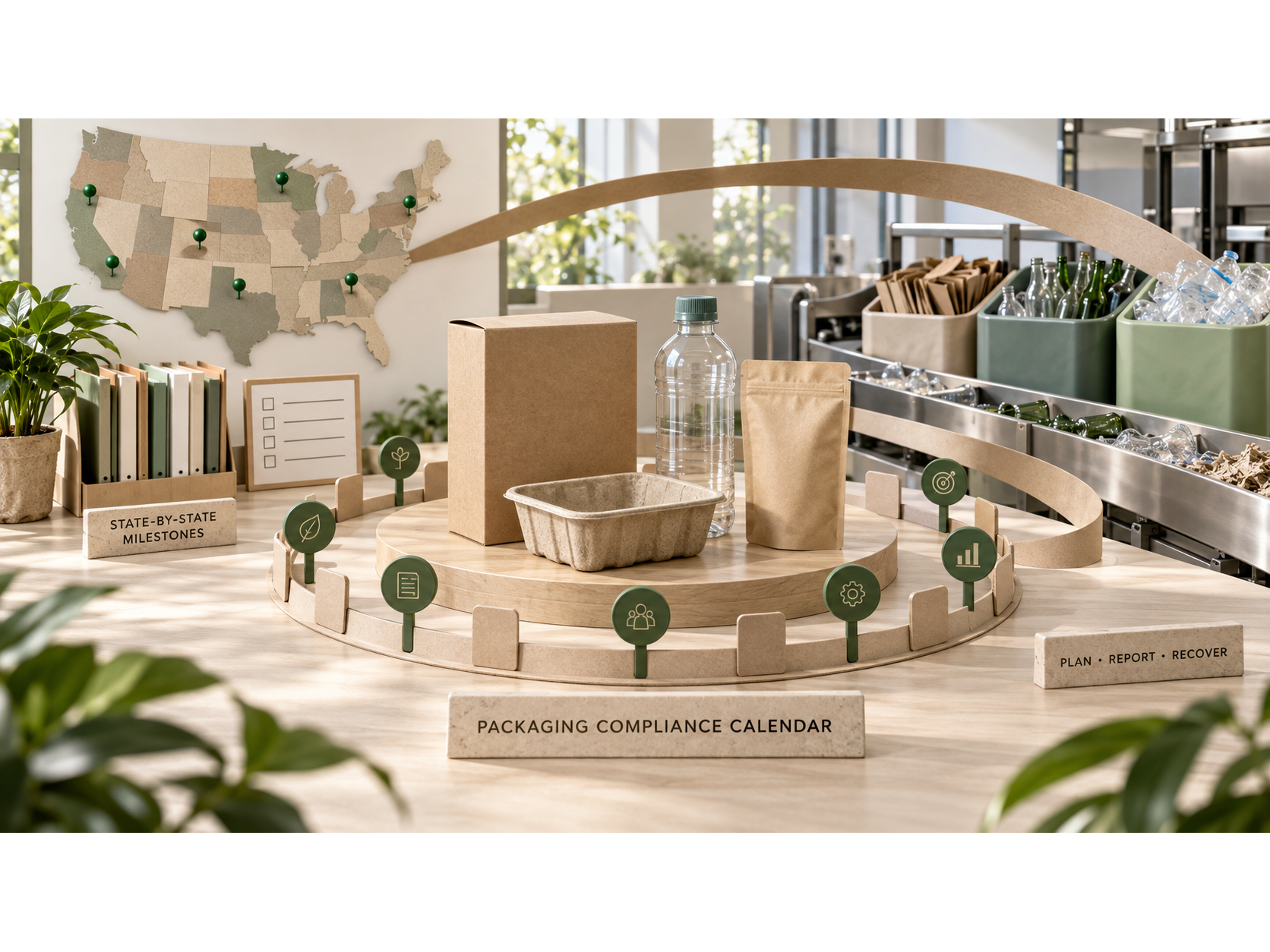
The Compliance Calendar Behind All of It
Seven states now run full extended producer responsibility programs, which put the cost of packaging recovery on the companies placing packaging on the market. As of late June 2026, California, Colorado, Maine, Maryland, Minnesota, Oregon, and Washington had enacted comprehensive packaging EPR laws, and the movement remains state-led rather than federal.
California's program is the largest by a wide margin. The Office of Administrative Law approved SB 54's implementing regulations on May 1, 2026, with a producer registration deadline of June 1, 2026 and full program implementation scheduled for January 1, 2027. By 2032 the law requires that all single-use packaging sold in California be recyclable or compostable, that 65 percent of single-use plastic packaging be recycled, and that single-use packaging be reduced 25 percent. CalRecycle estimates more than 5,700 producers fall within scope.
The legal landscape is unsettled. In June 2026 the NRDC, Californians Against Waste Foundation, and Oceana sued arguing the final rules are inconsistent with the statute, and a coalition of state attorneys general filed a separate challenge, while deadlines remain enforceable unless a court orders otherwise. A federal court in Oregon granted a preliminary injunction in February 2026 in an industry challenge to that state's EPR law.
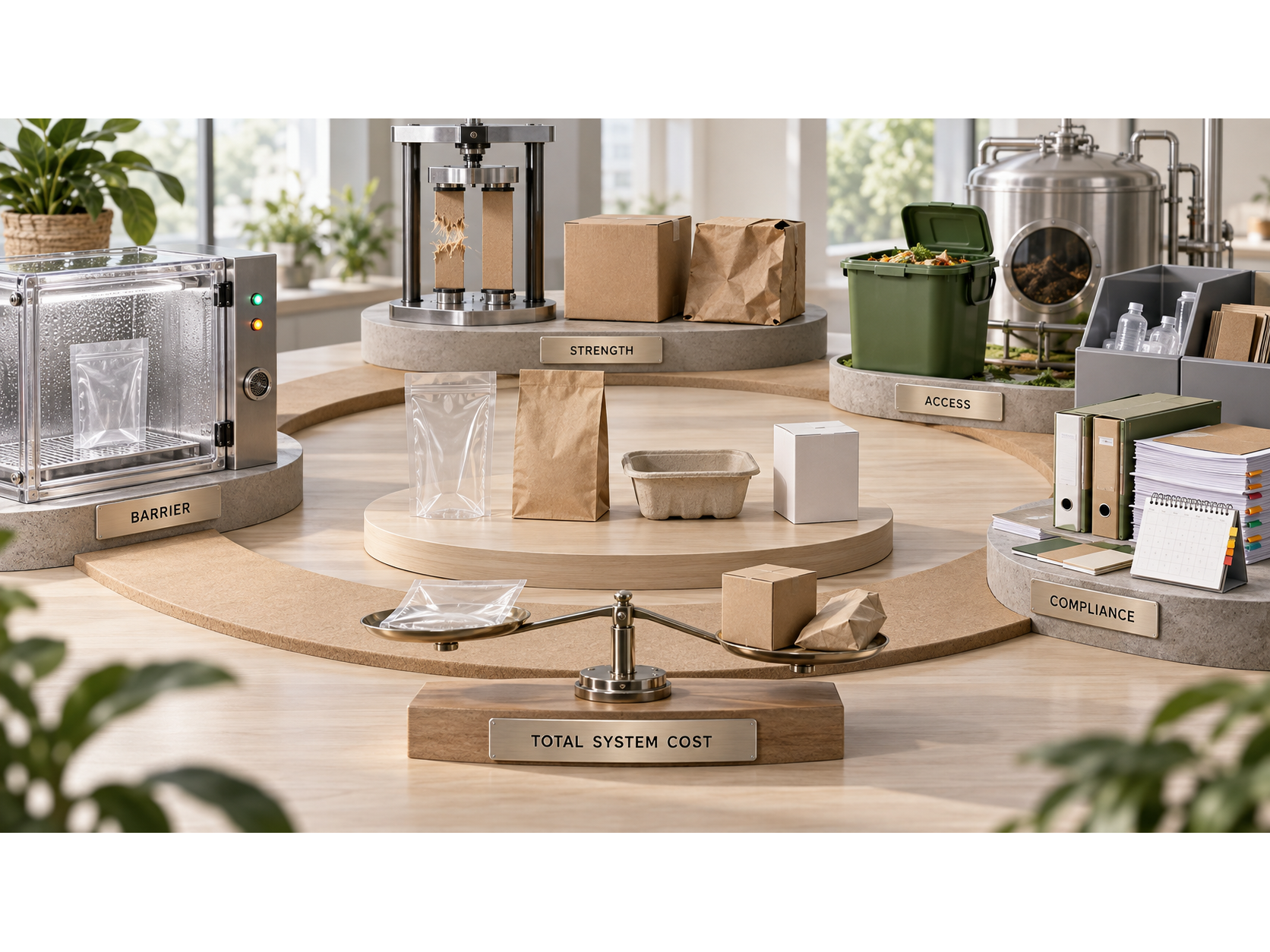
What Sustainable Packaging Costs You
Every guide on this topic lists benefits. The trade-offs are where projects actually fail.
Barrier is the first thing you pay. A mono-material recyclable structure will not match a foil laminate on oxygen and moisture barrier. For a dry product with a short turn, that difference is invisible. For coffee, for anything with volatile aromatics, or for a twelve-month shelf life, it is the whole decision.
Recycled content costs strength. Recycled fiber has been through the process before and comes out shorter, which reduces tear strength. That is why heavy multiwall sacks are usually virgin fiber. Recycled grades belong in different jobs: a wrap, a void fill, a bag that never carries load.
Compostable costs access. A certified compostable package that ends up in a curbside recycling bin is a contaminant. In a region without industrial composting, it is landfill with a certification fee attached.
Lighter is not automatically better. A thinner structure that fails in transit generates a replacement product and a replacement package. Product loss usually outweighs packaging weight in total impact.
The compliance work is itself a cost. SKU-level material data, supplier declarations, certificates with current expiry dates, and records substantiating each claim are an operating requirement now. They do not end when the launch does.
Sustainable Packaging Examples That Hold Up
A short list of specifications that survive scrutiny:
Corrugated shipping cases. The strongest recyclability position available, given documented recovery rates. Avoid full-coverage lamination, which can take the box out of the paper stream.
Uncoated or minimally coated folding cartons. Recyclable where paper is collected. A window, a laminate, or a synthetic closure each changes the answer.
Mono-material PE or PP stand-up pouches. Recyclable through drop-off, with dramatically lower freight volume than rigid formats. Requires a qualified claim.
PCR content in a non-food-contact layer. Meets state mandates without triggering the FDA question. Confirm the percentage is certified and confirm which layer it sits in.
Right-sized cartons and mailers. The least glamorous intervention and often the largest measurable one, since parcel carriers bill on dimensional weight and a half-empty box pays for the air in every shipment.
Five Questions Before You Commit
Protection. What does the product actually need in moisture, oxygen, grease, light, and aroma barrier over its real shelf life, not its ideal one?
Recovery. Where can this specific finished package go in the markets where it sells, given local collection rather than theoretical recyclability?
Claims. Which exact words go on the panel, and what document substantiates each one?
Compliance. Which state programs cover this SKU, and what reporting or registration does that trigger?
Freight and loss. What does the packed configuration do to dimensional weight, and what damage rate does the structure carry?
A spec sheet passes tests that a filled, sealed, shipped package does not. Conversion trials show cracking on the score, seals that do not hold, and color that drifted. Product trials show odor pickup, migration, and leaks. ASTM D4169 covers distribution testing of loaded shipping units, and the word that matters there is loaded.
Start From the Package's Job, Not From the Material
Brown is a color, not a credential. Unbleached board and recycled board are different things, and neither one automatically makes a package better in every use. A heavier recycled carton that has to be double-boxed to survive shipping can end up worse than a lighter virgin one that does not.
The order that works: decide what the package has to survive and what it legally has to say, pick the material family against those requirements, pick the grade inside the family, then confirm the whole construction on a converted, filled, tested package before a single claim goes near the artwork.
"Is this sustainable" has no answer on its own. "Can this package carry the word recyclable in the states where we sell it" has one, and it is the question worth asking first.