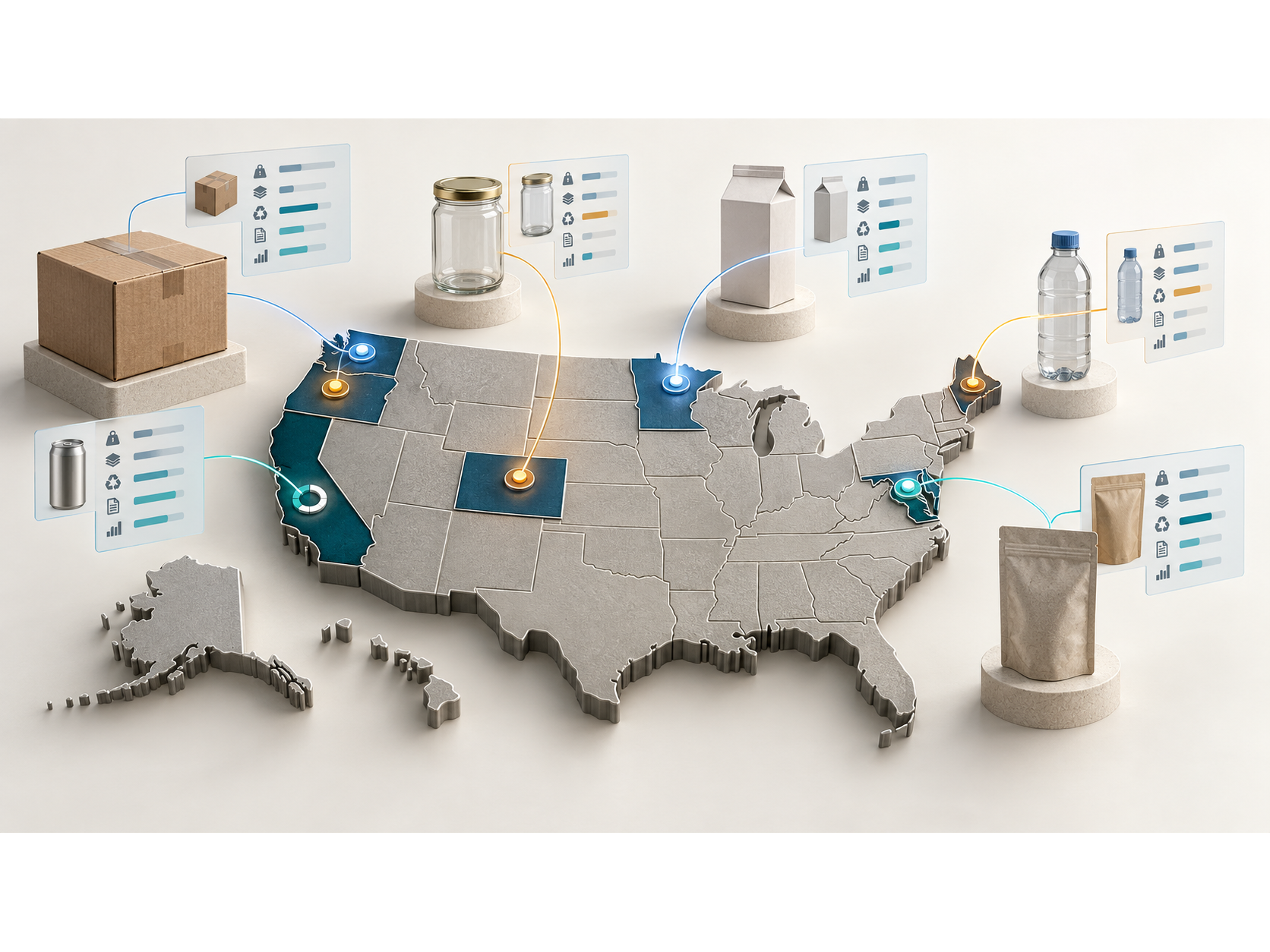
The most important sustainable packaging news in the United States is not a single material breakthrough. It is the shift from voluntary ambition to operating requirements.
As of September 21, 2026, seven states—California, Colorado, Maine, Maryland, Minnesota, Oregon, and Washington—had enacted extended producer responsibility laws for packaging. Their programs are not moving in unison. Oregon is generating operating data, Colorado is funding initial services, California has permanent regulations, Maryland and Washington have current producer obligations, Minnesota is developing rules and a needs assessment, and Maine is revising its implementation schedule. Packaging Dive's state tracker provides an independent overview; the state sources below control for program-specific details.
For CPG leaders, the strategic change is straightforward: packaging weight, material category, recyclability, claims, and state sales exposure are becoming connected financial and compliance data. A sustainability statement is no longer a substitute for a state-ready packaging record.
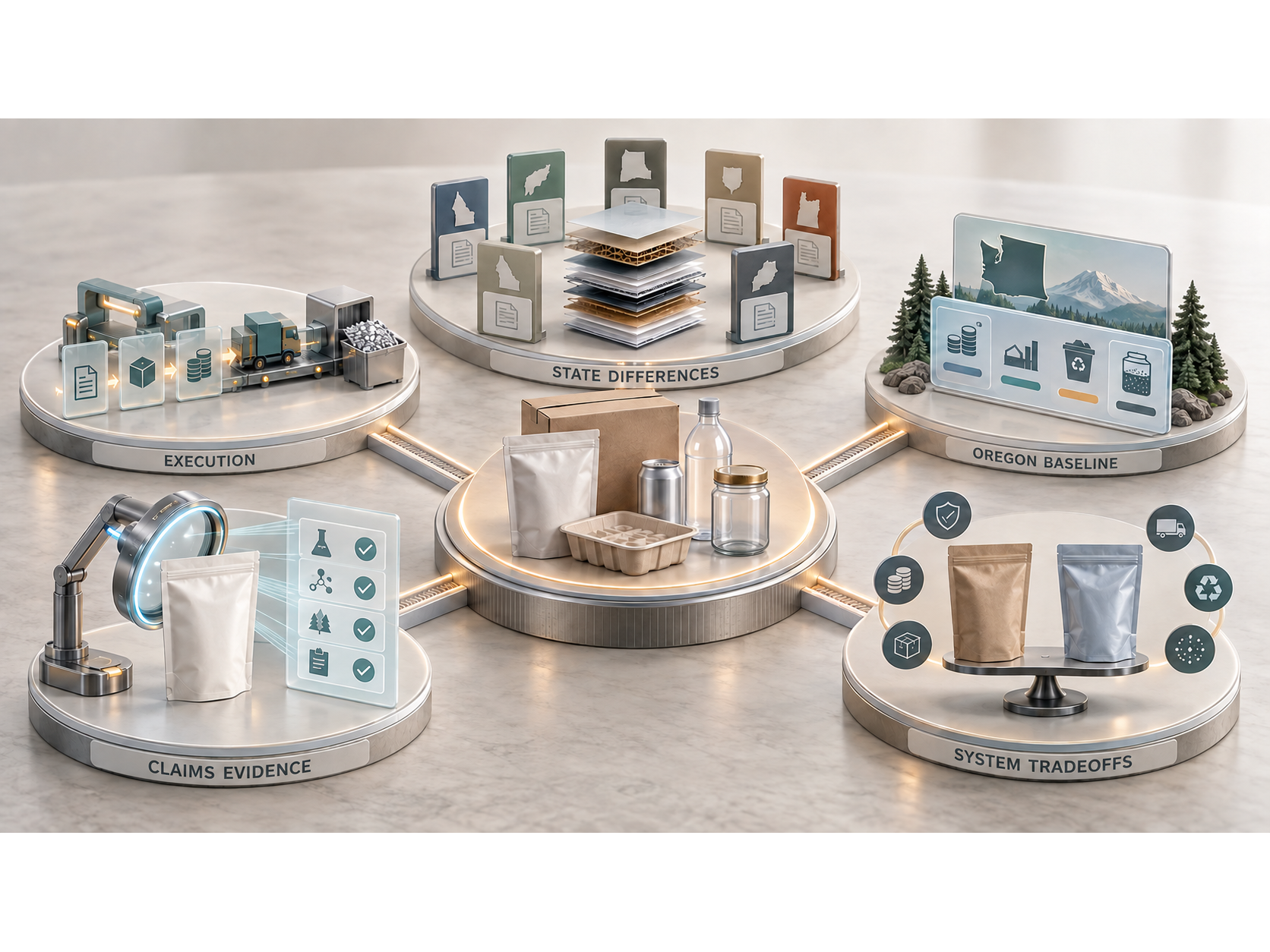
The 2026 news in five points
Packaging EPR has entered execution. Producers are registering, reporting packaging supply, paying fees, and funding collection and processing in several states.
The seven programs are materially different. A national packaging bill of materials is essential, but producer definitions, exclusions, categories, dates, and fee systems still require state-level analysis.
Oregon's first report offers an early operating baseline—not a national scorecard. Its first reporting period shows real revenue, equipment, collection, and contamination data, but it covers an implementation phase in one state.
Environmental claims are becoming more data-dependent. California's labeling rules and the Federal Trade Commission's existing Green Guides make broad “green” language risky without specific substantiation.
Material substitution is not automatically system improvement. Paper recovery is substantial, yet current work on paper-based flexible packaging shows that product protection, cost, sourcing, collection, recycling, and biodegradation must be considered together.
U.S. packaging EPR: a seven-state status table
Table 1. Packaging EPR status as of September 21, 2026.
State | Law enacted | Position in 2026 | Current signal for CPG brands |
|---|---|---|---|
California | 2022 | Permanent SB 54 regulations became effective May 1, 2026; Circular Action Alliance submitted a PRO plan on June 15. | Determine producer status, map covered-material categories, maintain weight and source-reduction data, and model the statutory targets. |
Colorado | 2022 | The final program plan was approved December 9, 2025; producers remitted dues by January 1, 2026; implementation began in early 2026. | Budget for a live producer-funded program and monitor forthcoming eco-modulation rules. |
Maine | 2021 | The program is at step four of nine: contracting a stewardship organization. No proposals were submitted by the August 20 deadline; DEP said on September 11 that it would revise the RFP and schedule. | Do not treat the original schedule as fixed. Prepare data now; registration is due within 90 days after the selected organization makes its mechanism available. |
Maryland | 2025 | Final regulations became effective May 25, 2026. Annual registration and associated fee requirements began July 1, 2026. | Confirm the obligated producer for each channel and report brands and covered-material weight through the applicable compliance route. |
Minnesota | 2024 | Rulemaking is underway; comments on the draft 2026 Needs Assessment are open through November 13. | Join the required PRO if obligated, preserve 2025 supply data, and track definitions and collection-list decisions still being developed. |
Oregon | 2021 | Producer fees began July 1, 2025; registration, reporting, fee payment, and system investments are operating. | Treat Oregon as an active compliance and cost center. The top 25 producers by market share have a first lifecycle-impact disclosure deadline of December 31, 2026. |
Washington | 2025 | In 2026, covered producers must register with the approved PRO, report covered products, pay membership fees, and comply with the Recycling Reform Act. | Establish state-specific reporting now; broad service expansion and at least 90% system-cost reimbursement begin in 2030. |
The table reveals the real operating problem: “EPR-ready” is not one checkbox. A company may be paying program fees in Oregon and Colorado, filing current data in Maryland and Washington, preparing California source-reduction records, and monitoring still-developing rules in Minnesota—all while Maine's startup schedule is being reset.
The common data foundation should therefore be national, while the legal logic remains state-specific. At minimum, a packaging record should connect each SKU to brand ownership, sales channel, state sales, component, material, format, weight, recycled content, relevant certification or test evidence, supplier, and artwork version.
Oregon provides the first operating data—along with important limits
Oregon launched the first U.S. producer-funded EPR program for paper and packaging in July 2025. Circular Action Alliance's first annual report and an independent Packaging Dive analysis provide an early view of where producer payments and infrastructure spending are going.
Table 2. Selected figures from Oregon's first reporting period.
Metric | Reported result | How to interpret it |
|---|---|---|
Participating producers | 2,909 | Program participation count for the reporting period, not the number of consumer brands or SKUs. |
Covered products reported as supplied | Nearly 410,000 U.S. short tons | Supply volume reported by producers; it is not a recycling-rate numerator. |
Material collected through applicable programs | 144,771 U.S. short tons | Collection volume across commingled, depot, and other applicable programs. Do not divide it by reported supply without reconciling periods, scope, and methodology. |
Glass collected and recycled through the curbside incentive program | 18,888 U.S. short tons | A material- and program-specific result. |
Contamination rate in sampled material | 24.73% | Based on 554 audits, most representing the Portland area; not necessarily representative of all Oregon routes. |
Producer-fee revenue | $167.9 million | Program revenue, not environmental benefit. |
Program expenditure | $56.5 million | Includes startup costs during the implementation period. |
Accumulated reserves | $111.4 million | Reflects timing as major investments continue through 2026 and 2027; it should not be read as permanent underspending. |
RecycleOn centers at December 2025 | 20 | Early physical-access buildout; CAA's plan calls for further expansion. |
Recycling containers ordered | 42,297 | Equipment input, not a direct measure of recovered tonnage or participation. |
Collection trucks ordered | 12 | Infrastructure input during program startup. |
These figures matter because they move the conversation from pledges to system economics. They also show why one headline number is insufficient. A brand needs to distinguish inputs—fees, carts, trucks, and sites—from outputs such as collected tons, processed quality, verified end markets, and actual environmental outcomes.
The limitations are equally important. The 2025 report covers the first six months of an implementation-stage program; CAA is the producer responsibility organization and the source of the underlying report. The contamination result comes from a geographically concentrated audit sample. Oregon's figures should be used as a developing benchmark, not projected across the United States.
California links packaging design, data, and long-term targets
California's permanent SB 54 regulations took effect on May 1, 2026. The state also operates the Packaging Extended Producer Responsibility System for registration, data submission, and compliance tracking. According to CalRecycle's producer guidance, statutory milestones include:
Table 3. Selected California SB 54 packaging targets.
Date | Single-use plastic source reduction | Single-use plastic recycling | Packaging design outcome |
|---|---|---|---|
January 1, 2027 | 10% less | — | — |
January 1, 2028 | — | 30% | — |
January 1, 2030 | 20% less | 40% | — |
January 1, 2032 | 25% less | 65% | 100% recyclable or compostable packaging |
These are program targets governed by California's law and regulations; they are not a claim that every individual package must already achieve each percentage today. Producers should confirm how baselines, categories, exemptions, PRO participation, and individual compliance apply to their portfolios.
California's separate SB 343 “Truth in Recycling” law also shows why artwork cannot be separated from recovery data. CalRecycle states that labeling restrictions are scheduled to apply to products and packaging manufactured after October 4, 2026, but a July 14 preliminary injunction currently blocks enforcement; the agency cautions that the deadline may be affected by the ongoing case. The underlying CalRecycle labeling page remains the appropriate status source. Brands should not guess how litigation changes their obligations—legal counsel should review the current order, product facts, and artwork before release.
Sustainable packaging news now includes chemistry and claims
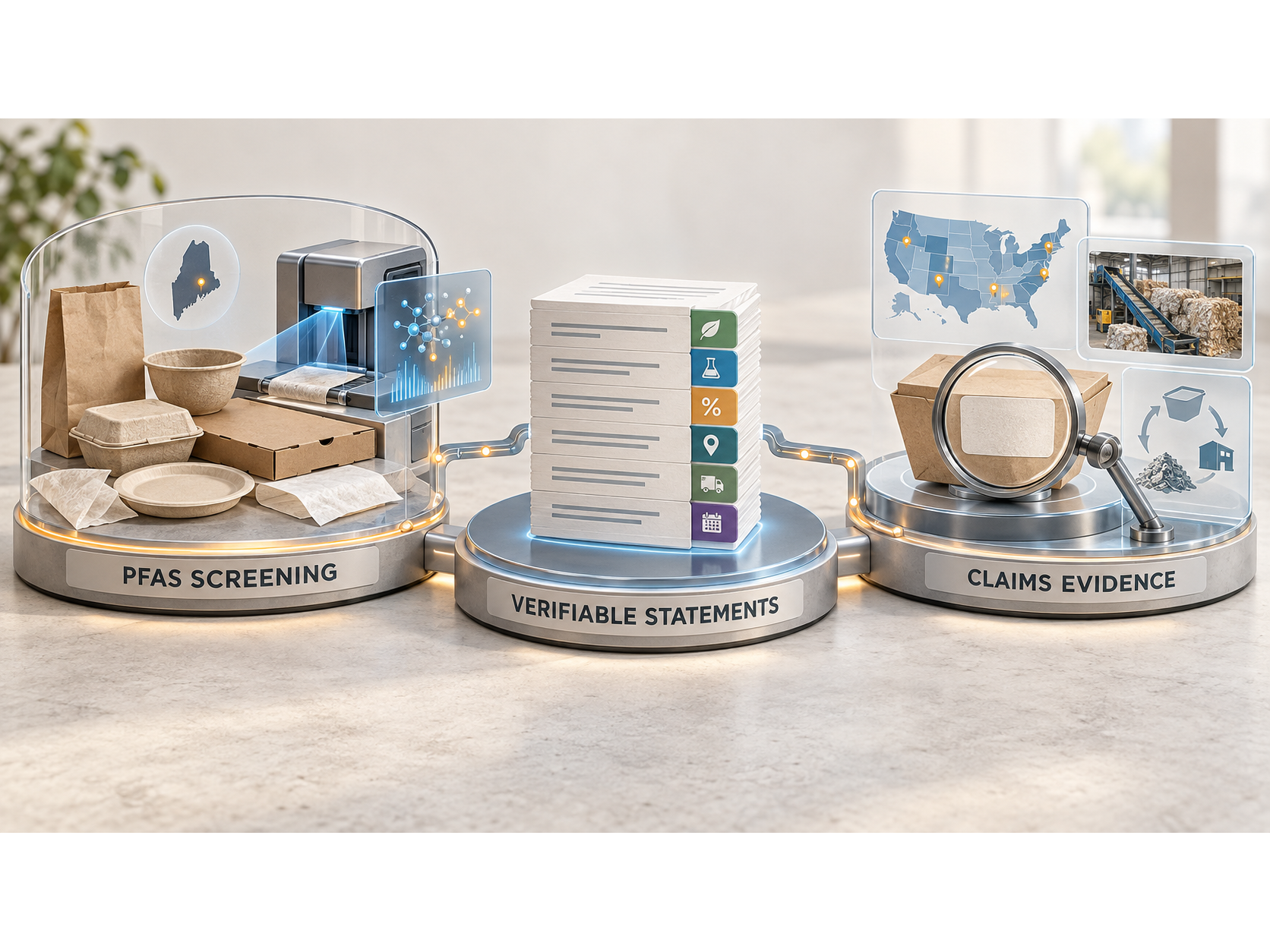
Packaging compliance is extending beyond recycling-system finance. Maine's rule prohibiting intentionally introduced PFAS above incidental presence took effect May 25, 2026 for specified direct-food-contact packaging made substantially from paper, paperboard, or other plant fibers. The covered formats include defined categories such as bags and sleeves, bowls, closed containers, pizza boxes, plates, and wraps and liners, subject to the rule's scope and exemptions. It is not a blanket statement that every package sold in Maine is covered. Maine DEP describes the affected applications and limits.
Claims require their own evidence file. The FTC's Green Guides page identifies 2012 as the most recent revision and documents the agency's review activity. Current guidance advises against broad, unqualified claims such as “green” or “eco-friendly,” calls for scientific substantiation, and says recyclable claims should be qualified when appropriate facilities are not available to at least 60% of consumers or communities where the item is sold. A state-law analysis may produce a different or additional requirement; following one framework does not automatically satisfy all others.
For packaging teams, the practical rule is to break a broad sustainability message into verifiable statements: the component involved, the measured attribute, the percentage or comparison basis, the geography, the collection pathway, and the date of the evidence.
Paper is important—but “switch to paper” is not a complete strategy
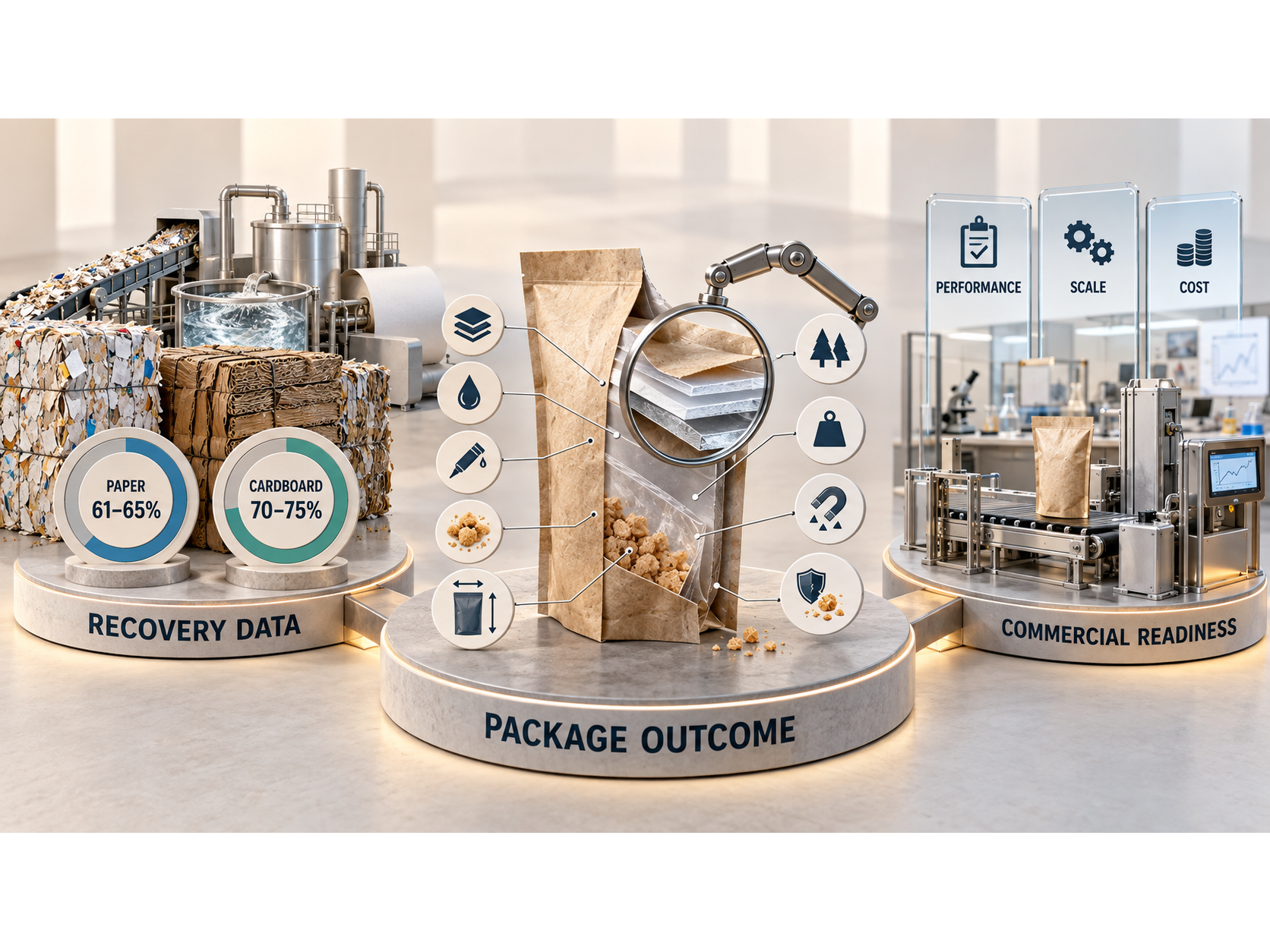
The American Forest & Paper Association estimated that in 2025, 61%–65% of paper and 70%–75% of cardboard available for recovery was recycled in the United States. It reported about 45 million U.S. short tons of paper recovered, including more than 33 million tons of cardboard; U.S. mills used 31.4 million tons of recycled paper, down 1.3 million tons from 2024. Nearly half of recovered paper went into containerboard. AF&PA published the figures on August 28, 2026.
Those are useful system indicators, but they are industry-association estimates based on material available for recovery. They do not establish that every fiber package is accepted, sorted, reprocessed, or environmentally preferable to every plastic alternative. Barrier layers, coatings, adhesives, food residue, format size, fiber sourcing, package weight, and product loss can change the outcome.
The latest innovation news reinforces that caution. On September 16, 2026, the Ellen MacArthur Foundation announced the PaperFlex Consortium, founded by Colgate-Palmolive, Mars, Nestlé, PepsiCo, Procter & Gamble, and Unilever. Its aim is collaborative R&D on paper-based alternatives to small-format flexible plastic packaging. The Foundation also states that responsible solutions do not yet exist at the performance, scale, and cost required. A consortium launch is evidence of investment and an unsolved technical problem—not evidence that a commercial solution is ready for every SKU.
What this means for CPG leaders
The strongest response is not to wait for a perfect national standard. It is to build a packaging operating system that can absorb state differences without rebuilding the data from scratch.
Table 4. A 90-day sustainable-packaging action plan.
Workstream | Days 0–30 | Days 31–60 | Days 61–90 | Suggested owner |
|---|---|---|---|---|
Regulatory scope | Identify potentially obligated legal entities, brands, channels, and exemptions in all seven EPR states. | Have counsel validate producer determinations and active deadlines. | Create a controlled state obligation calendar with named owners. | Legal / regulatory |
Packaging data | Build a component-level material and weight template; prioritize missing weights. | Reconcile supplier specifications, state categories, recycled content, and 2025 supply data. | Lock version control and an evidence-retention process. | Packaging / data |
Finance | Record current dues and fees separately from future estimates. | Model cost by state, material, and SKU; separate confirmed rates from scenarios. | Add EPR sensitivity to landed-cost and innovation decisions. | Finance / procurement |
Design | Rank SKUs by packaging mass, fee exposure, claims risk, and redesign timing. | Develop reduction, reuse, or material-change concepts for high-priority SKUs. | Run product-protection, distribution, line, shelf-life, and consumer-use validation before conversion. | Packaging engineering / R&D |
Claims and artwork | Inventory “recyclable,” “compostable,” “biodegradable,” “PFAS-free,” “green,” and reduction claims. | Link each claim to substantiation, component scope, geography, disposal pathway, and artwork version. | Remove, qualify, or escalate claims that lack current evidence. | Legal / brand |
Governance | Name one cross-functional decision owner. | Establish a monthly change review for laws, fee schedules, materials, and artwork. | Approve a launch gate requiring regulatory, technical, cost, and claims sign-off. | Operations / sustainability |
This sequence prevents three expensive mistakes: redesigning before the data is usable, treating a laboratory-compatible material as system-recyclable, and approving a claim that no longer matches the package or market.
Frequently Asked Questions
How many U.S. states have packaging EPR laws?
Seven states had enacted packaging EPR laws as of September 21, 2026: California, Colorado, Maine, Maryland, Minnesota, Oregon, and Washington. Their scopes and implementation stages differ, and new legislation or rule changes can alter the count and obligations.
Does “sustainable packaging” mean “recyclable packaging”?
No. Recyclability is one possible attribute. A sound decision also considers source reduction, reuse, recycled content, toxicity, responsible sourcing, product protection, manufacturing loss, transport, actual collection and processing, and verified end markets. Trade-offs should be documented rather than hidden behind a general claim.
Should a CPG brand replace flexible plastic with paper now?
Not by default. The alternative must protect the product, run on the intended equipment, meet food-contact or other category rules, survive distribution, provide an appropriate end-of-life pathway, and support accurate claims. Current consortium work shows that some paper-based flexible applications still face performance, scale, and cost gaps.
What packaging metric should brands prioritize first?
Start with component-level material and weight by SKU and market. That data supports EPR reporting, fee estimates, reduction work, supplier validation, and redesign prioritization. It should then be paired with recovery, contamination, recycled-content, performance, and claims evidence; no single metric proves overall sustainability.