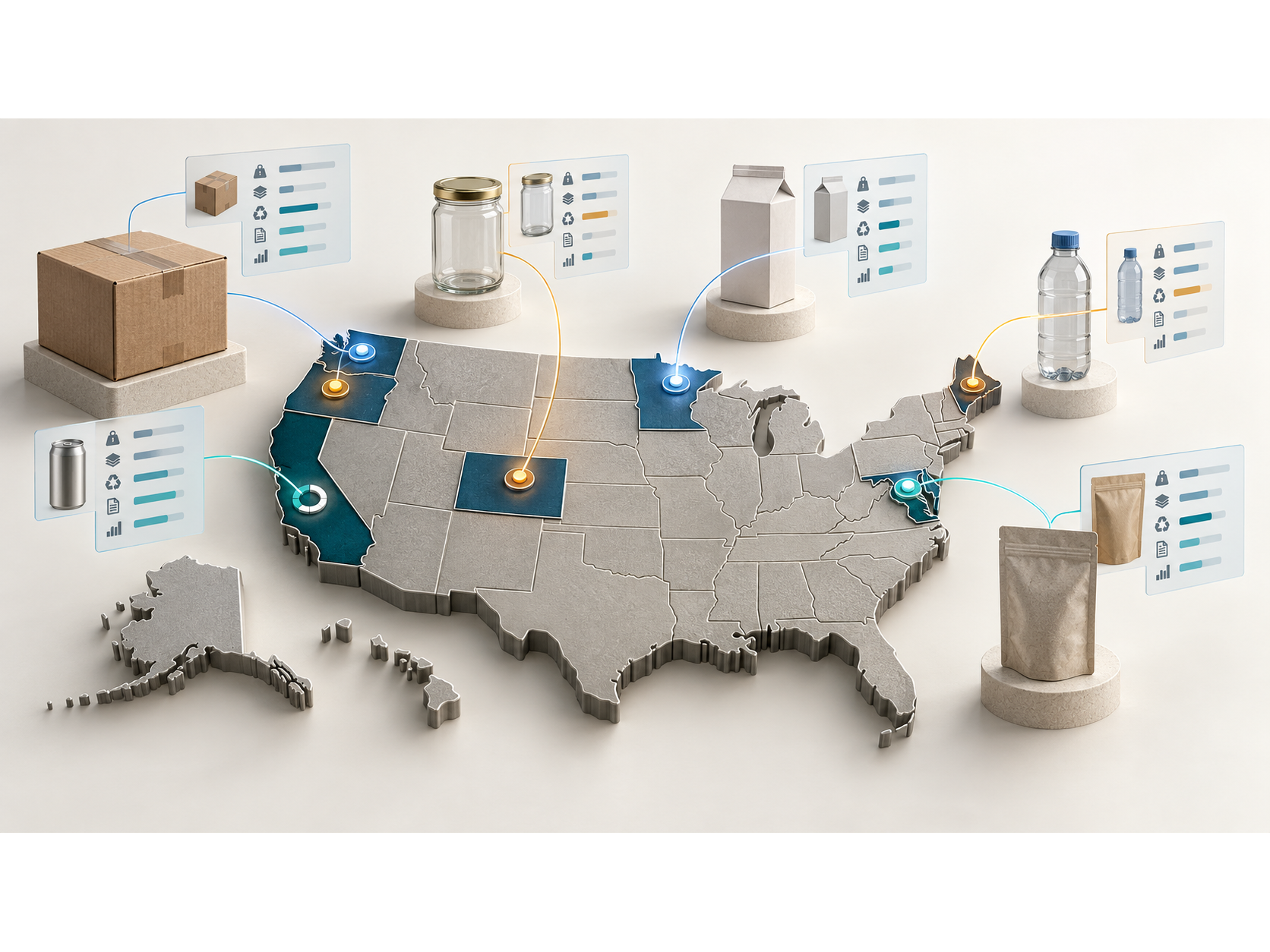
2026 is the year several long-running packaging policies started producing deadlines, fees, and documentation requests. Five shifts account for most of it.
Sustainability decisions have moved from the marketing brief into operations. The decisions that matter in 2026 are which state programs you are registered in, what your supplier can certify in writing, and whether the material you specified is still available at the price you were quoted.
Extended Producer Responsibility Became an Operating Requirement
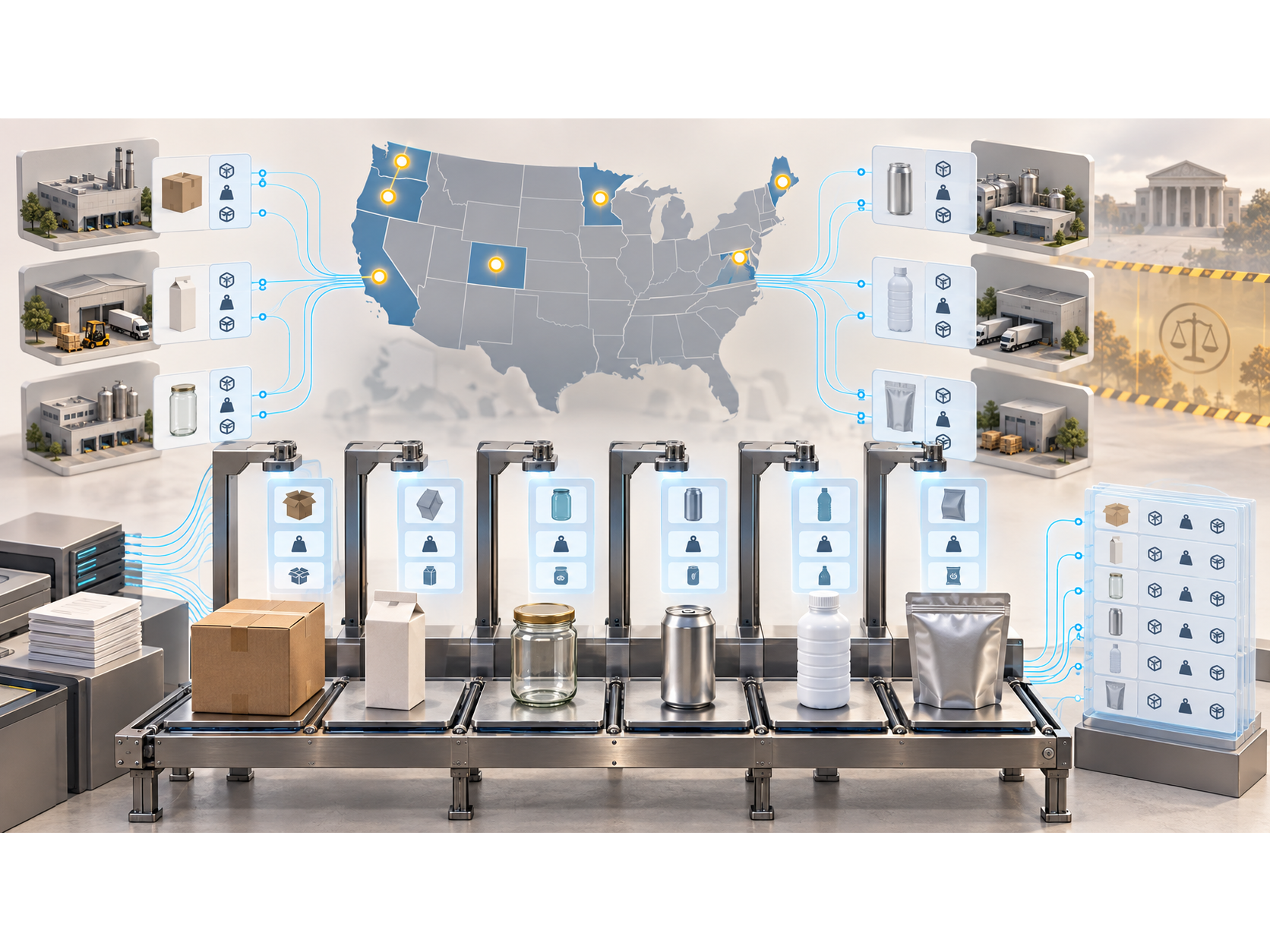
Seven states now run comprehensive packaging EPR programs, which make the companies placing packaging on the market financially responsible for collecting and processing it. As of late June 2026, California, Colorado, Maine, Maryland, Minnesota, Oregon, and Washington had enacted these laws, and there is no federal equivalent.
In California, the Office of Administrative Law approved SB 54's implementing regulations on May 1, 2026, producers had until June 1, 2026 to register, and full program implementation is scheduled for January 1, 2027. CalRecycle estimates more than 5,700 producers fall within scope, which is several times the size of any other EPR program the state runs.
The reason this matters operationally has nothing to do with sustainability strategy. EPR reporting requires SKU-level data on covered material type, weight, and category for every product sold into the state, and for companies working with contract manufacturers that data sits scattered across supplier records. The work is not deciding to be more sustainable. It is finding out what your packaging actually weighs and what it is made of, SKU by SKU, and being able to produce that on request.
One caveat worth carrying: the legal ground is not settled. In June 2026 the NRDC, Californians Against Waste Foundation, and Oceana filed suit arguing the final rules are inconsistent with the statute, and a coalition of state attorneys general filed separately, while deadlines remain enforceable unless a court orders otherwise. A federal court in Oregon granted a preliminary injunction in February 2026 in an industry challenge to that state's law. The prudent position is to comply on the published timeline and watch the litigation.
Recyclability Became a Test You Can Fail
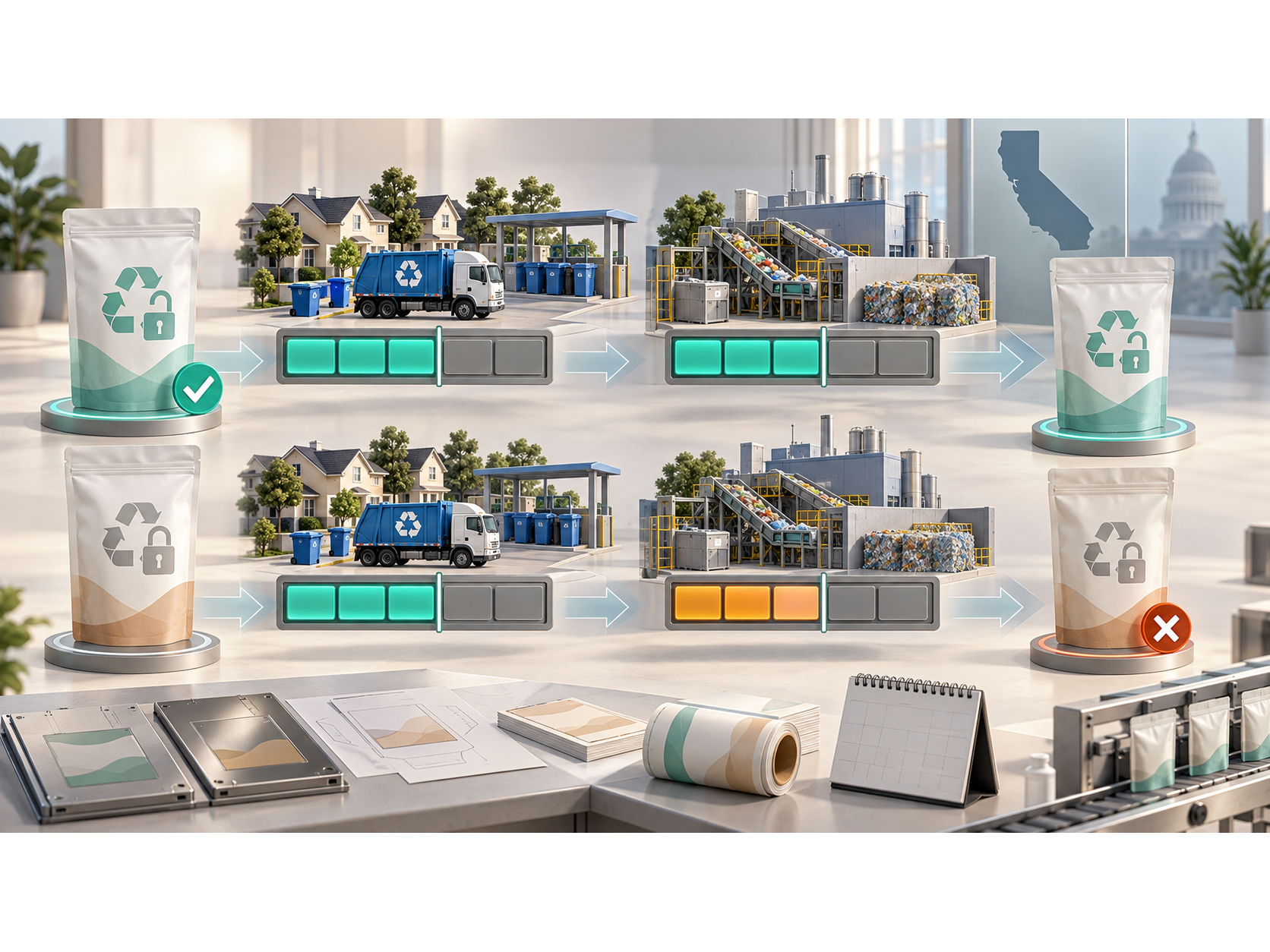
For two decades, "recyclable" was a marketing word. In 2026 it became a claim with a pass/fail threshold behind it in the largest US state market.
California SB 343 restricts the chasing arrows symbol and any implied recyclability claim to materials meeting statewide criteria, including a 60 percent collection threshold and a 60 percent processing threshold. The restrictions apply to products and packaging manufactured after October 4, 2026, which is 18 months after CalRecycle published its final material characterization findings.
The date drives the artwork, not the sell-through. Anything manufactured before October 4 is exempt regardless of when it sells, which means the deadline lands on production schedules rather than on inventory.
A federal court granted a preliminary injunction on July 14, 2026 pausing California Attorney General enforcement, though the compliance date and other enforcement paths remain relevant for companies not party to the litigation. The practical effect for most brands is unchanged: the artwork revision still has to happen, because the second material characterization study lands in 2027 and starts another 18-month clock.
We covered the full claims framework, including what the FTC Green Guides require and how compostable and recycled-content claims differ, in our guide to what sustainable packaging actually means.

PFAS Moved From a Chemistry Question to a Documentation Question
This is the shift most packaging buyers underestimated, because it does not look like a sustainability issue until a retailer asks for a certificate.
At least twelve states have enacted laws restricting PFAS in food packaging, with more taking effect through 2026 and 2027. The problem is that the laws do not agree with each other. Some states target only specific materials such as plant-fiber packaging, while others cover all food packaging, and the compliance thresholds differ.
Most laws define compliance through a total organic fluorine measurement, typically 100 ppm in the earlier statutes and dropping to 20 or 50 ppm in newer or amended ones. California's 100 ppm TOF threshold has become a de facto industry benchmark, and Washington's amended rule creates a rebuttable presumption of intentionally added PFAS above its threshold, ratcheting from 100 ppm down to 50 ppm starting in January 2027.
Federal action came earlier and narrower. FDA announced in February 2024 that PFAS grease-proofing substances were no longer being sold for food-contact use in the US, which means a grade name that was compliant in 2023 may not be compliant now.
The operational consequence: a supplier attestation alone is thin. A usable certificate names the product and SKU, states that no PFAS were intentionally added during manufacturing, and ideally references supporting test data, and independent total organic fluorine screening adds a verification layer that an attestation does not.
If you sell greaseproof paper, molded fiber, coated fiber bowls, or anything that resists oil, this is a live procurement question rather than a future one.

The EU Became a Second Rulebook for US Brands
The Packaging and Packaging Waste Regulation, Regulation (EU) 2025/40, entered into force on February 11, 2025 and generally applies from August 12, 2026, replacing a thirty-year-old directive with a single framework that applies uniformly across all member states.
Two things make this relevant to a US brand that has never thought about Brussels.
First, jurisdiction follows market access rather than company location. It applies to manufacturers, importers, brand owners, distributors, and ecommerce sellers placing packaging on the EU market, including packaging manufactured outside the EU.
Second, the first wave of requirements includes PFAS restrictions on food-contact packaging from August 12, 2026, alongside recyclability requirements, with harmonized labeling generally applying from August 2028 and stricter design-for-recycling rules from 2030.
The penalty structure is what gets attention internally. Non-compliant companies face fines in the range of 2 to 6 percent of global annual turnover, with severe violations leading to market access bans.
For a US CPG brand selling into Europe through a distributor or through its own ecommerce storefront, the practical 2026 task is establishing who holds the obligation in that chain and collecting the technical documentation to support it.

The Recycled Content Squeeze Got Worse, Not Better
This is the trend that runs opposite to expectations, and it is the one most likely to affect a quote you receive this year.
Recycled content mandates are escalating. California, Washington, New Jersey, Maine, and Connecticut require post-consumer recycled content in plastic packaging, with targets rising toward 50 percent for beverage containers in several states by the early 2030s. California's AB 793 already requires 25 percent PCR in plastic beverage containers, rising to 50 percent by 2030.
At the same time, the US market that is supposed to supply that material is under pressure. Rising volumes of imported recycled resin and softening demand in some segments squeezed domestic producers through 2025, with tariff uncertainty, consumer spending, and the cost gap between international and American material all contributing. An unprecedented number of domestic PET reclaimers closed in that period.
Industry discussion at the 2026 Plastics Recycling Conference centered on exactly this mismatch: mandates expanding while domestic PCR demand stays soft, with panelists arguing that EPR incentives alone cannot close the cost gap between virgin resin, imported recycled resin, and domestic recycled content.
Globally, recycled resins are projected to hold roughly a 20 percent price premium over virgin alternatives, and food-grade PCR supply remains constrained by collection inefficiencies, contamination, and the technical difficulty of decontamination for sensitive applications.
For a brand specifying PCR in 2026, that produces three practical realities. Food-grade PCR is the scarcest and most expensive category. Certified PCR with traceable chain of custody costs more than uncertified. And a percentage you commit to in artwork is a supply commitment you have to hold for the life of that artwork.
What Design Teams Are Actually Doing About It
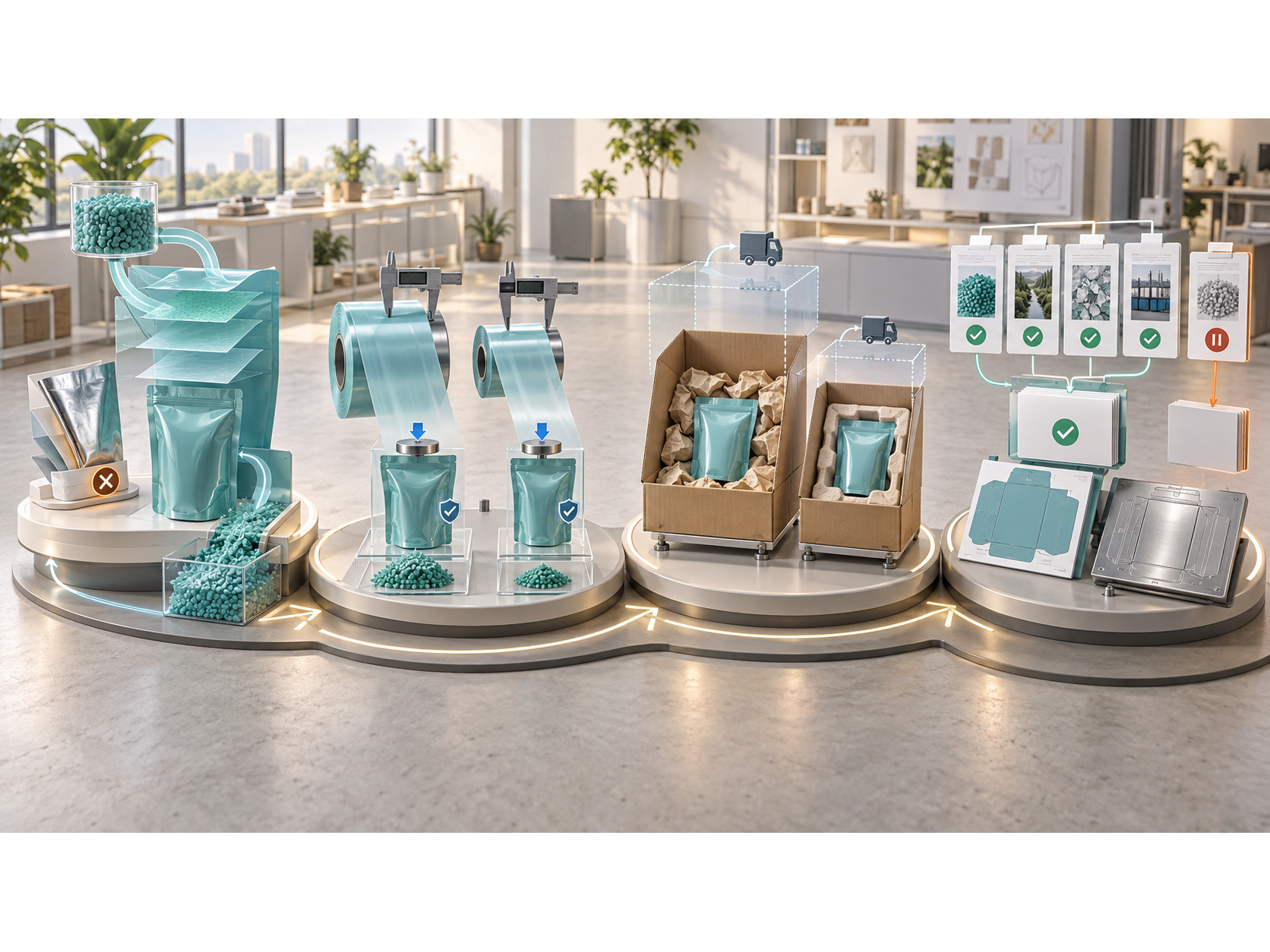
The design response to all of the above has converged on a short list, and none of it is new technology.
Mono-material structures. Keeping every layer of a flexible package in one polymer family so the whole thing stays in one recycling stream. The barrier comes from a metallized layer of the same polymer rather than from foil or a second plastic. It gives up some barrier performance against the best mixed laminate and buys back a defensible recyclability position.
Down-gauging. Reducing material thickness where the structure allows it, which lowers both material cost and the amount of PCR you have to buy to hit a percentage. Procurement and engineering teams are using down-gauging, polyolefin blends, and substrate substitution specifically to offset the premium on recycled content.
Right-sizing. The least discussed and often largest single lever, because parcel carriers bill on dimensional weight and a half-empty box pays for the air in every shipment rather than once.
Specification gating. Building PCR content, chain-of-custody, and end-of-life requirements into RFPs and supplier pre-qualification rather than discovering them at proofing.
The 2026 Compliance Calendar in One Table
Date | What applies | Who it affects |
|---|---|---|
Jan 1, 2026 | Minnesota compostable labeling requires third-party certification | Anyone labeling packaging compostable in MN |
Jan 1, 2026 | California single-use plastic carryout bag ban at checkout | Retail |
May 1, 2026 | California SB 54 permanent regulations effective | All covered producers selling into CA |
Jun 1, 2026 | SB 54 producer registration deadline | Estimated 5,700+ producers |
Aug 12, 2026 | EU PPWR generally applies, including food-contact PFAS restrictions | Anyone placing packaging on the EU market |
Oct 4, 2026 | California SB 343 labeling restrictions apply by manufacture date | Anyone using recyclability claims or symbols |
Jan 1, 2027 | SB 54 full program implementation; Washington PFAS threshold drops to 50 ppm | Producers and food packaging suppliers |
2027 | CalRecycle second material characterization study | Starts a new 18-month labeling clock |
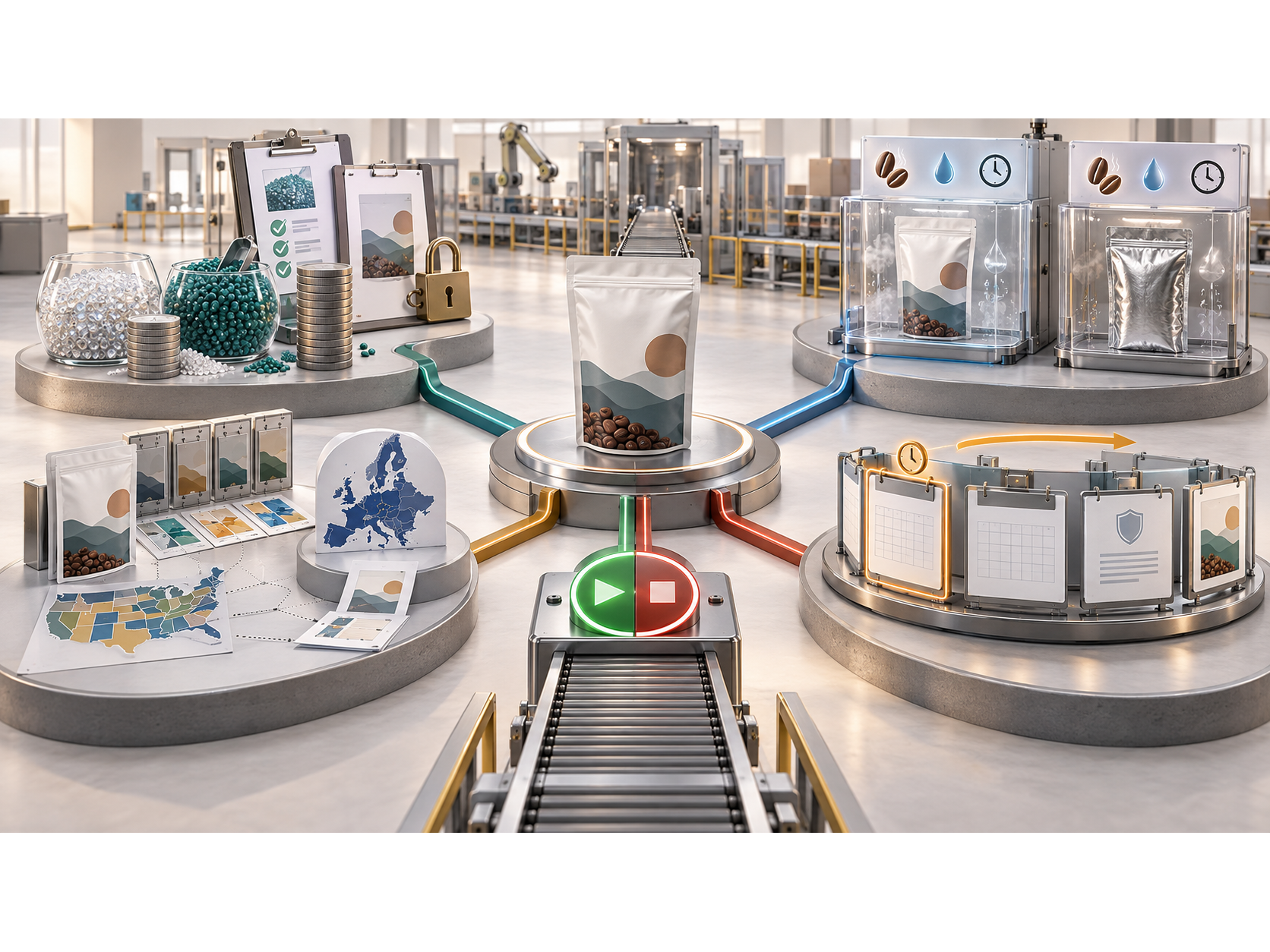
What These Trends Cost You
Every trends article lists opportunities. The costs are more useful, because they are what actually determines whether a project happens.
Recycled content carries a price premium and a supply risk. A PCR percentage printed on a panel is a commitment you have to be able to source for as long as that artwork runs. Locking supply matters more than locking price.
Recyclable structures give up barrier. A mono-material pouch will not match a foil laminate on oxygen and moisture. For a dry product with quick turns that is invisible. For coffee, for volatile aromatics, or for a twelve-month shelf life, it is the whole decision.
Multi-market selling multiplies everything. A label compliant in one state may not be compliant in another, and a package compliant in the US may not clear the EU. The cost is rarely the material. It is the second and third version of the artwork.
And the rules keep moving. The California study cycle alone guarantees another labeling review in 2027, with findings republished every five years after that. Packaging built to the current rules has a known expiry.
Five Questions Worth Asking Before Your Next Order
Registration. Which state EPR programs cover your SKUs, and are you registered or exempt in each?
Data. Can you produce material type, weight, and category for every SKU sold into a covered state without asking a supplier to dig?
Claims. Which exact words and symbols appear on each panel, and which document substantiates each one for each market?
PFAS. For any grease-resistant or fiber-based food packaging, do you hold a current certificate naming the SKU, and has anything been screened for total organic fluorine?
Supply. If you are committing to a PCR percentage in artwork, is it contracted or quoted?
The Real Trend Is That Packaging Decisions Now Have Dates on Them
The sustainability conversation used to run on intention. A brand decided to be better about packaging, chose a material that reflected that, and put a word on the panel.
In 2026 it runs on calendars and documents. The material decision is still a design decision, and it now arrives attached to a registration deadline, a threshold measured in parts per million, a certificate with an expiry date, and a supply contract for a resin that costs more than it did last year.
That makes the useful question narrower than it used to be. Rather than asking whether packaging is sustainable, ask which specific obligations attach to this SKU in the markets where it sells, and whether you can produce the paperwork for each one. The brands finding 2026 manageable are the ones who started collecting that paperwork before anyone asked for it.