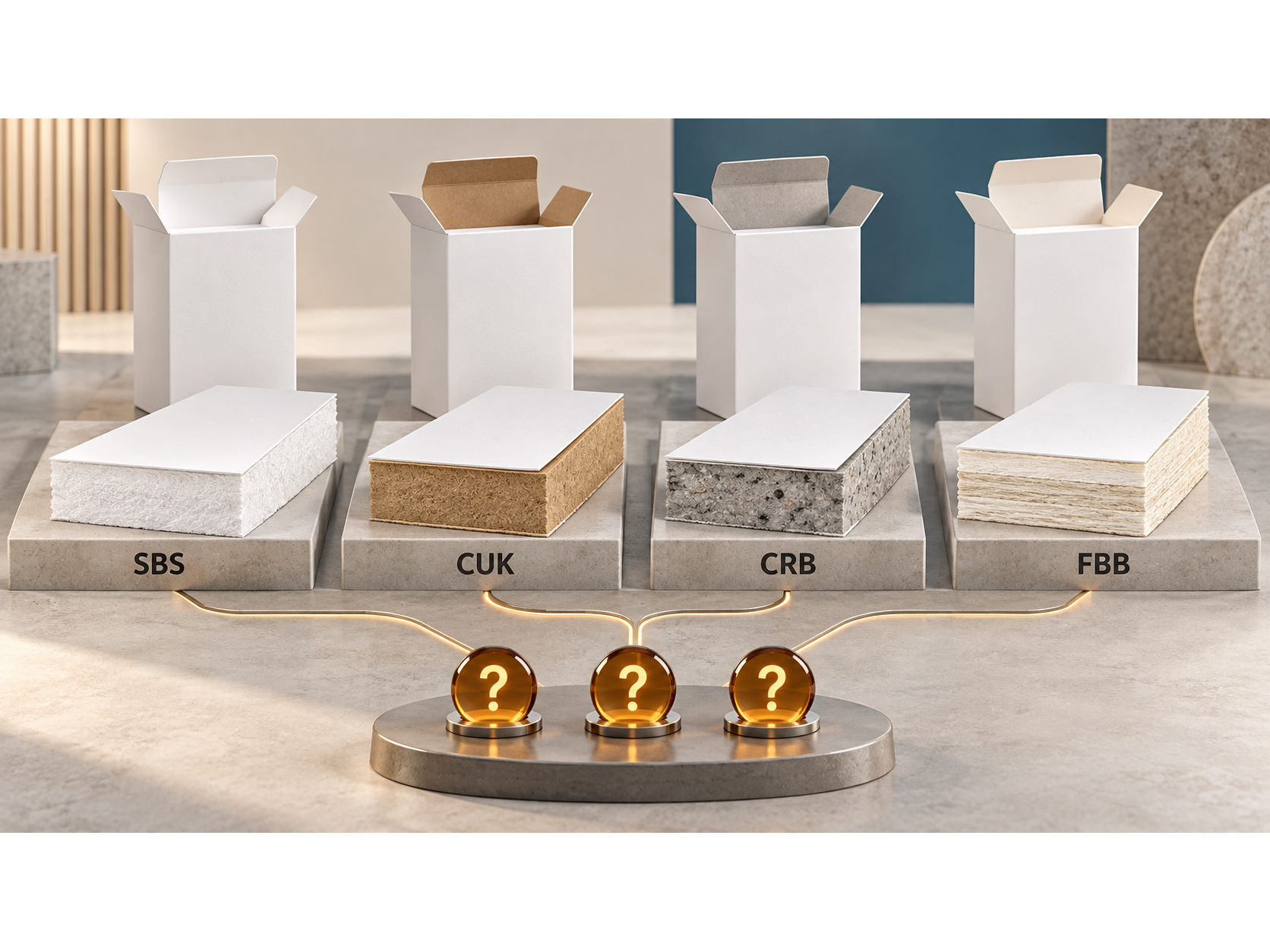
You ask for a paper box and the quote comes back asking whether you want SBS, CUK, CRB or FBB. Four abbreviations, no explanation, and a decision you are apparently supposed to already know how to make.
Here is the thing that makes it manageable: those four are all the same kind of thing. They are grades of paperboard, and picking between them comes down to three questions about your product. Most of the confusion in packaging paper is not that the choice is hard. It is that the words sit at different levels and nobody says which level they are on.

Three Levels, Not One List
Professional packaging conversations usually separate three groups:
Paper is flexible. It bends, wraps, and makes bags. Kraft is here.
Paperboard is stiff enough to hold a shape when you crease and fold it. Cartons are here, and so are SBS, CUK, CRB and FBB.
Containerboard is not a finished material at all. It is the liner and the fluted medium that get glued together to become corrugated board.
There is no clean thickness line between paper and paperboard. It varies by end use, and the boundary matters less than the grade, which is why a supplier's spec sheet tells you more than either word does.
One more distinction worth holding onto. A folding carton, a shipping case, a paper bag and a label are formats, not materials. Two of them can be made from the same board and behave completely differently. A quote needs both: the format you want and the grade it is made from.
The Main Types of Paper for Packaging
Nine families cover almost everything. The watch-outs column is the useful one, because that is where most sourcing mistakes live.
Material family | Typical strengths | Common CPG uses | Key watch-outs |
|---|---|---|---|
Kraft packaging paper | Flexible; natural and white grades can be engineered for strength, porosity, or converting | Grocery bags, wraps, mailers, multiwall sacks, interleaving | "Kraft" describes how the pulp was made, not the fiber source, the barrier, the strength or the color |
Glassine, greaseproof, parchment, and barrier paper | Selected for grease, moisture, aroma, oxygen, or release performance | Food wraps, liners, confectionery, bakery, quick-service packs, sachets | Similar appearance does not mean equivalent barrier; treatments affect sealing and recovery |
Tissue and interleaving paper | Lightweight separation, surface protection, and presentation | Beauty, gifting, glassware, premium unboxing | Not a structural replacement for cushioning or a shipping case |
Label paper | Printable face material used within an adhesive-label construction | Bottles, jars, cans, cartons, logistics labels | Face stock, adhesive, release liner, container surface, condensation, and application conditions must work together |
SBS | Solid bleached sulfate paperboard with a bright, consistent visual surface | Premium food, beauty, personal care, healthcare, and high-graphic folding cartons | Confirm stiffness, caliper, coatings, scoring, and food-contact suitability rather than buying on whiteness alone |
CUK, SUS, or CNK | Unbleached kraft-based paperboard, often with a coated white printing side and natural reverse | Beverage carriers, frozen food, household products, durable folding cartons | Naming varies by supplier; verify furnish, reverse-side appearance, coating, and performance |
CRB or CCNB | Recycled-fiber paperboard, commonly with a coated printing surface | Dry food, cereal, tissue, pet care, laundry, and general consumer cartons | Check odor, cleanliness, stiffness, moisture response, print target, and product-contact restrictions |
FBB | Multilayer folding boxboard designed to balance stiffness, bulk, and printability | Food, beauty, healthcare, confectionery, and other folding cartons | Same caliper can mean very different stiffness, because FBB is layered and the layers differ by mill |
Linerboard and corrugating medium | Combined into single-face, single-wall, double-wall, or triple-wall corrugated board | Shipping cases, e-commerce mailers, trays, displays, and protective retail packs | The combined-board specification and finished package matter more than one component sheet |
None of these is better than the others. Each family has dozens of grades inside it at different weights, coatings and performance levels, so the family name gets you into the right neighborhood and no further.
Kraft Gets You to the Neighborhood
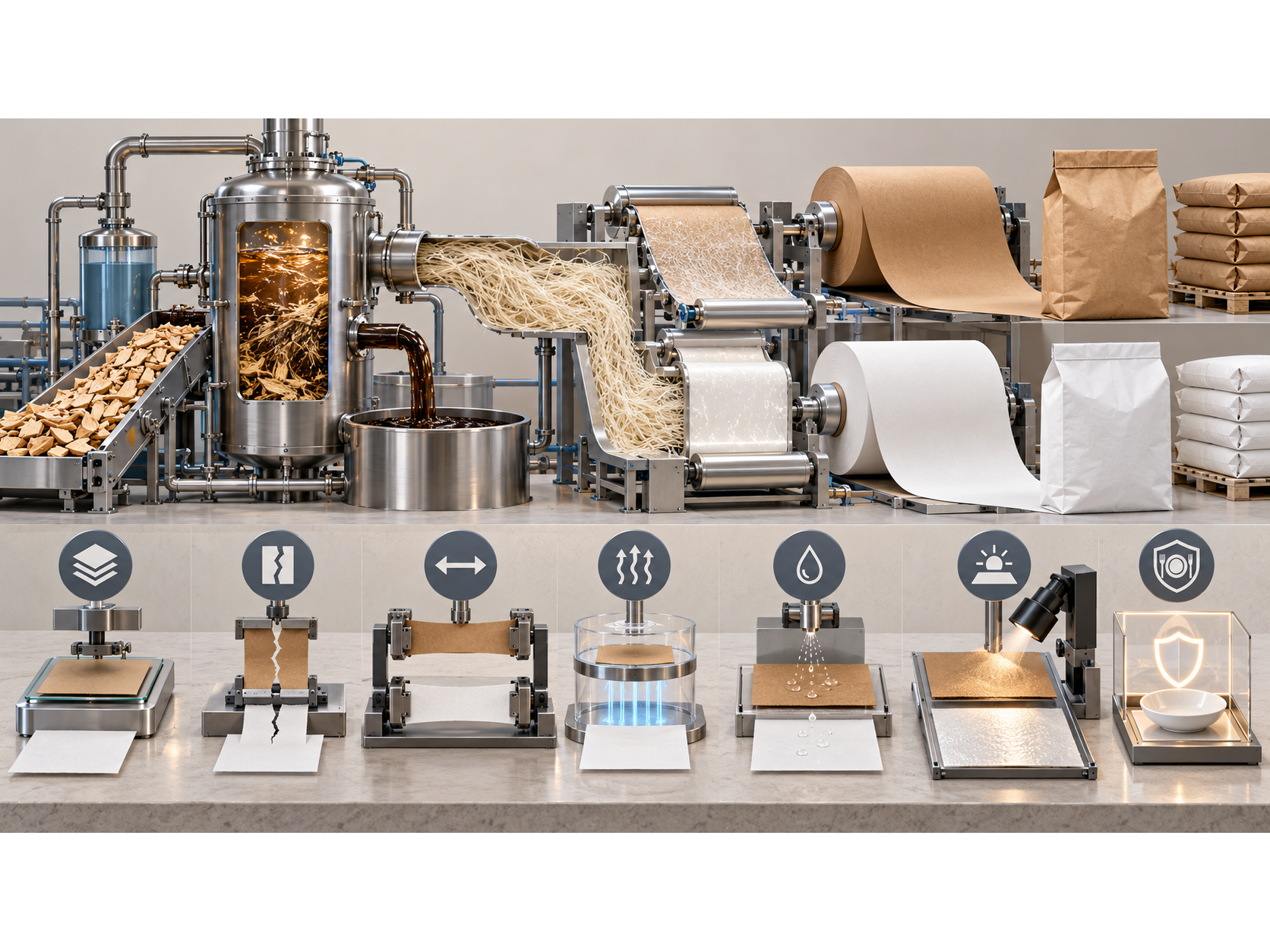
Kraft is a pulping process, not a look. Cooking wood chips with an alkaline solution strips out the lignin and leaves the cellulose fibers long, and long fibers are what resist tearing. That is the whole reason kraft is strong.
Brown is just unbleached kraft. Bleached white kraft is the same process with the lignin taken further out, and bleaching costs a measurable amount of strength, which is why heavy-duty sacks are usually left brown.
What a spec actually needs: grammage, tear and tensile, stretch, porosity, wet strength, surface finish, and whether it is cleared for the food contact you intend.
Which of the Four Board Grades
The four are easier to hold apart once you know what each one is made of.
SBS is bleached all the way through, so it is white on both sides. That is what you pay for and why it prints the best. Beauty, healthcare, anything with fine graphics.
CUK (also sold as SUS or CNK) is unbleached kraft with a coated white face. Kraft fiber underneath means it is stronger and it handles moisture better, which is why beverage carriers and frozen food use it. The reverse side stays brown.
CRB is recycled fiber with a coated print side. Cheapest of the four, and the recycled furnish is why it goes into dry goods: cereal, tissue, pet food, laundry.
FBB is layered on purpose, chemical pulp on the outside and a bulkier high-yield pulp in the middle, so it gets stiffness without the weight of a solid sheet.
Even with the right family, a spec still needs the mill, the grade designation, the weight or caliper, the coating, grain direction and tolerances. Grain direction is the one people forget: board is stiffer across the grain than along it, so a carton creased the wrong way against the grain cracks.
And if a supplier says "chipboard," ask which one they mean. It can be uncoated recycled board or the thick core inside a rigid box, and those are not close.
Corrugated Packaging Is an Engineered Board System
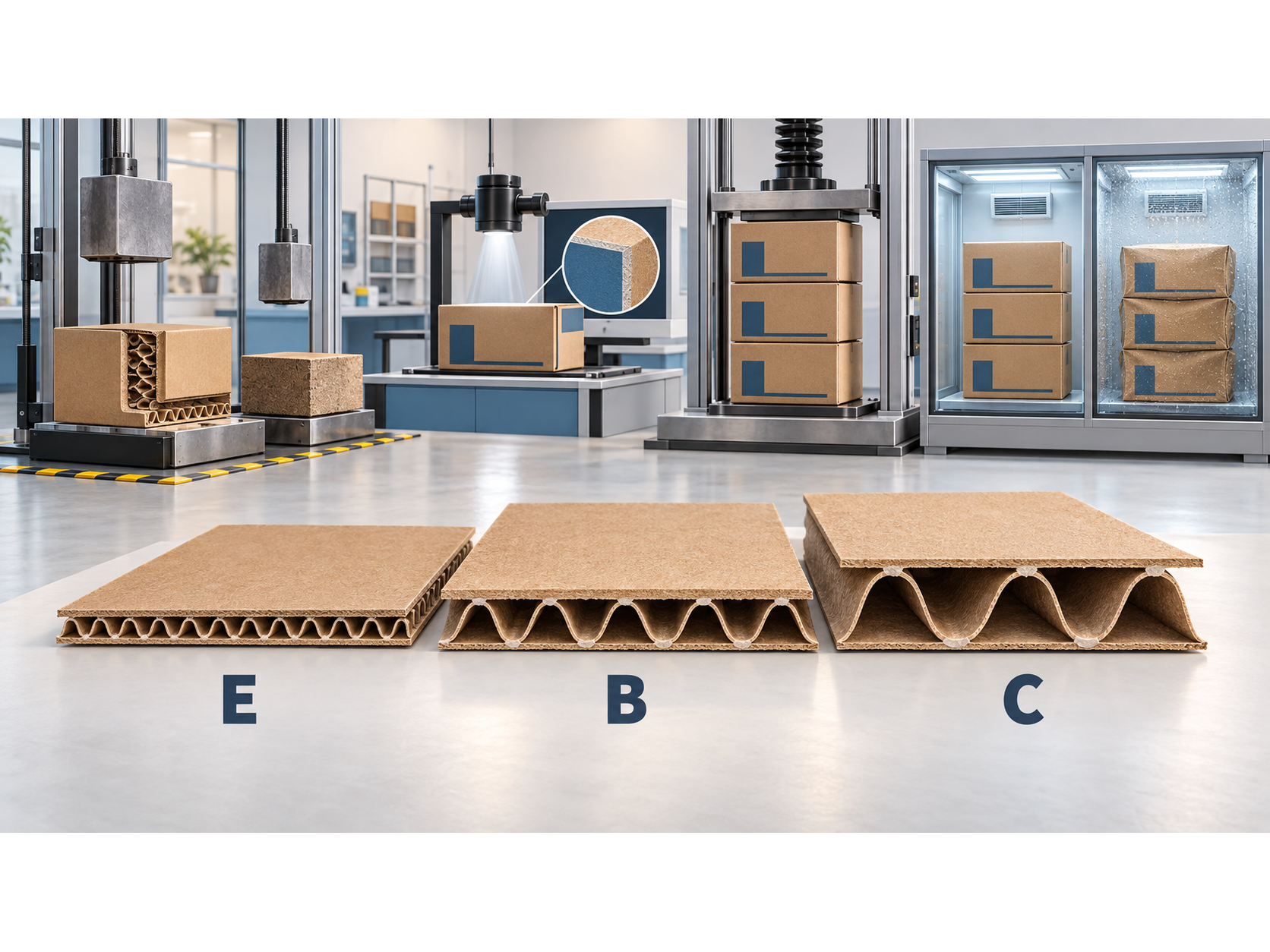
Corrugated is a sandwich: a fluted medium glued between two flat liners. The air in those flutes is what absorbs a drop, which is why corrugated protects and a flat sheet of the same weight does not.
Flute letters describe the size of that wave. E-flute is about 1.5 mm and prints reasonably well, B-flute is about 3 mm, C-flute is about 4 mm and stacks better. But the letter is not a strength rating, because stacking height, humidity, box geometry and what is inside all change the answer. Humidity in particular: corrugated loses compression strength in a damp warehouse, which is how a case that tested fine in January fails in July.
Barrier Performance Must Match the Product
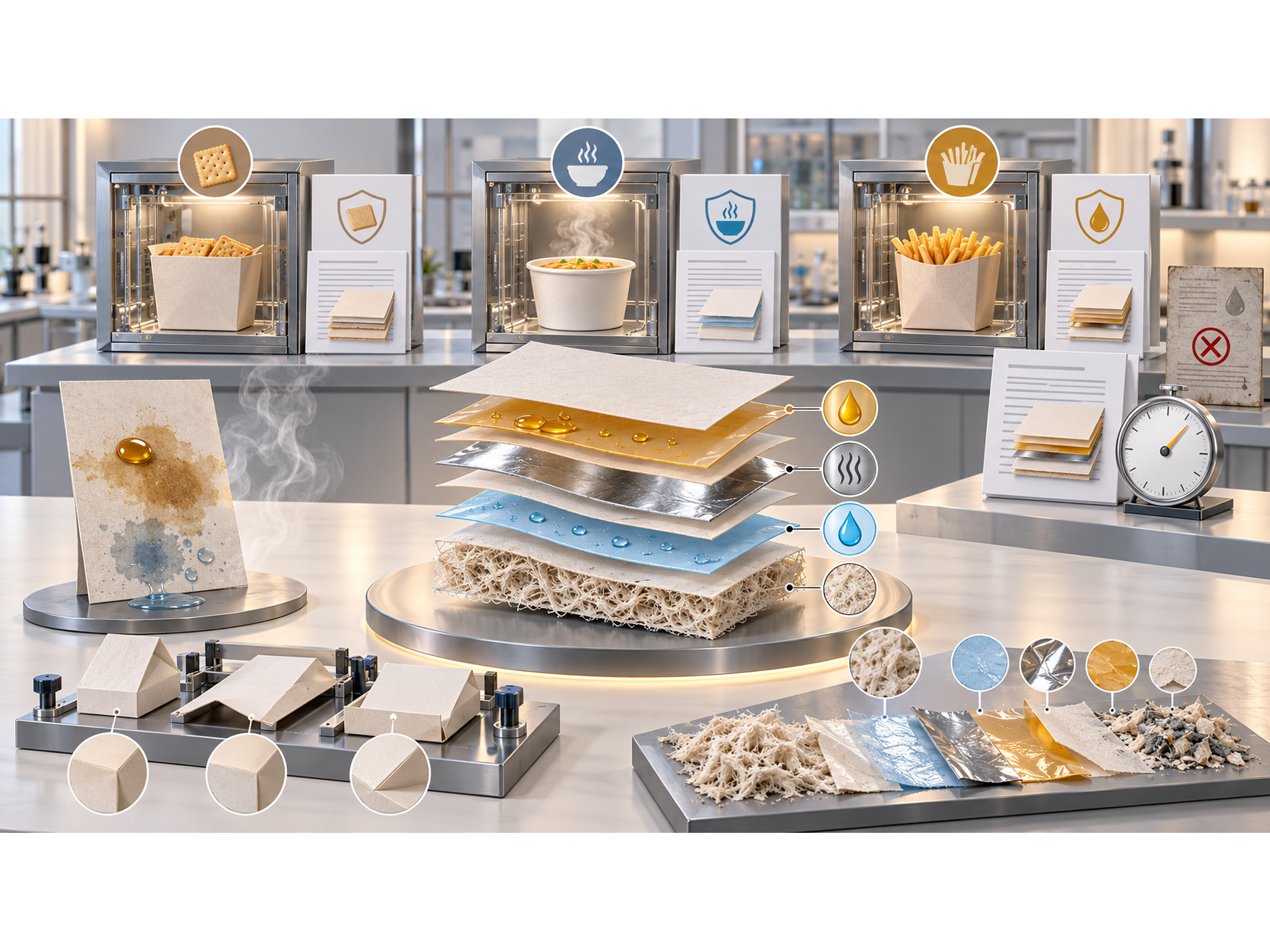
Paper on its own resists nothing. It absorbs grease, wicks water and lets aroma through. Every barrier function comes from something added to it: a dispersion or extrusion coating for moisture, a laminate or foil layer for oxygen, a grease barrier for oil. Each of those additions changes how the material converts and where the finished package can go at end of life.
For U.S. food applications the check covers the whole construction, not just the board. The FDA treats adhesives, coatings and polymers as food-contact components too, and authorization is tied to the intended use, so a material cleared for dry contact is not cleared for hot or greasy.
Grease-proofing deserves its own check. PFAS-based grease barriers were standard in food packaging for years, and the FDA has since withdrawn the notifications that covered them. A grade name that was fine in 2023 may not be fine now, so the declaration has to be current and specific to the material, not inherited from an old spec sheet.
Five Questions Before You Pick
A disciplined material brief should answer five questions:
Product protection: What stiffness, compression, tear, puncture, grease, moisture, oxygen, aroma, light, or temperature performance is required?
Conversion: Will the material print, coat, score, fold, glue, seal, form, fill, and run at the intended production conditions?
Communication. Can it hold the color, the fine type, the finish and a scannable barcode? A code that scans on white SBS can fail on brown kraft or across a crease, and GS1 recommends measuring it on the actual material with an ISO-compliant verifier rather than eyeballing a proof.
Economics and supply: What are the board yield, material and conversion costs, minimums, lead times, approved alternates, freight, storage, and obsolescence risk?
Recovery and claims: How do coatings, windows, adhesives, liners, food residue, and local systems affect the intended disposal instruction or marketing claim?
A flat sheet passes tests that a folded, filled, sealed package does not. Conversion trials are where you find cracking on the score, dusting, curl, seals that do not hold and color that drifted. Product trials are where you find odor pickup, migration and leaks. ASTM D4169 covers distribution testing of loaded shipping units, and the word that matters there is loaded.

Sustainability Requires More Than Choosing Brown Paper
Brown is a color, not a credential. Unbleached board and recycled board are different things, and neither one automatically makes a package better in every use. A heavier recycled carton that has to be double-boxed to survive shipping can end up worse than a lighter virgin one that does not.
Whatever gets printed on the panel needs its own evidence. The FTC Green Guides caution against broad, unqualified environmental claims and set out when recyclable and recycled-content claims need qualifying. [FTC link] A coating, a laminate, a window or a synthetic closure can each take a paper package out of the paper stream, so the claim belongs to the finished package, not to the board it started as.
Start From the Product, Not the Sample Book
The order that works: decide what the package has to survive and what it has to say, then pick the family, then pick the grade inside it, then confirm the whole thing on a converted, filled, tested package.
"Which paper should we use" does not have an answer on its own. It has an answer once you know what the product does to the paper and what the distribution does to the package.