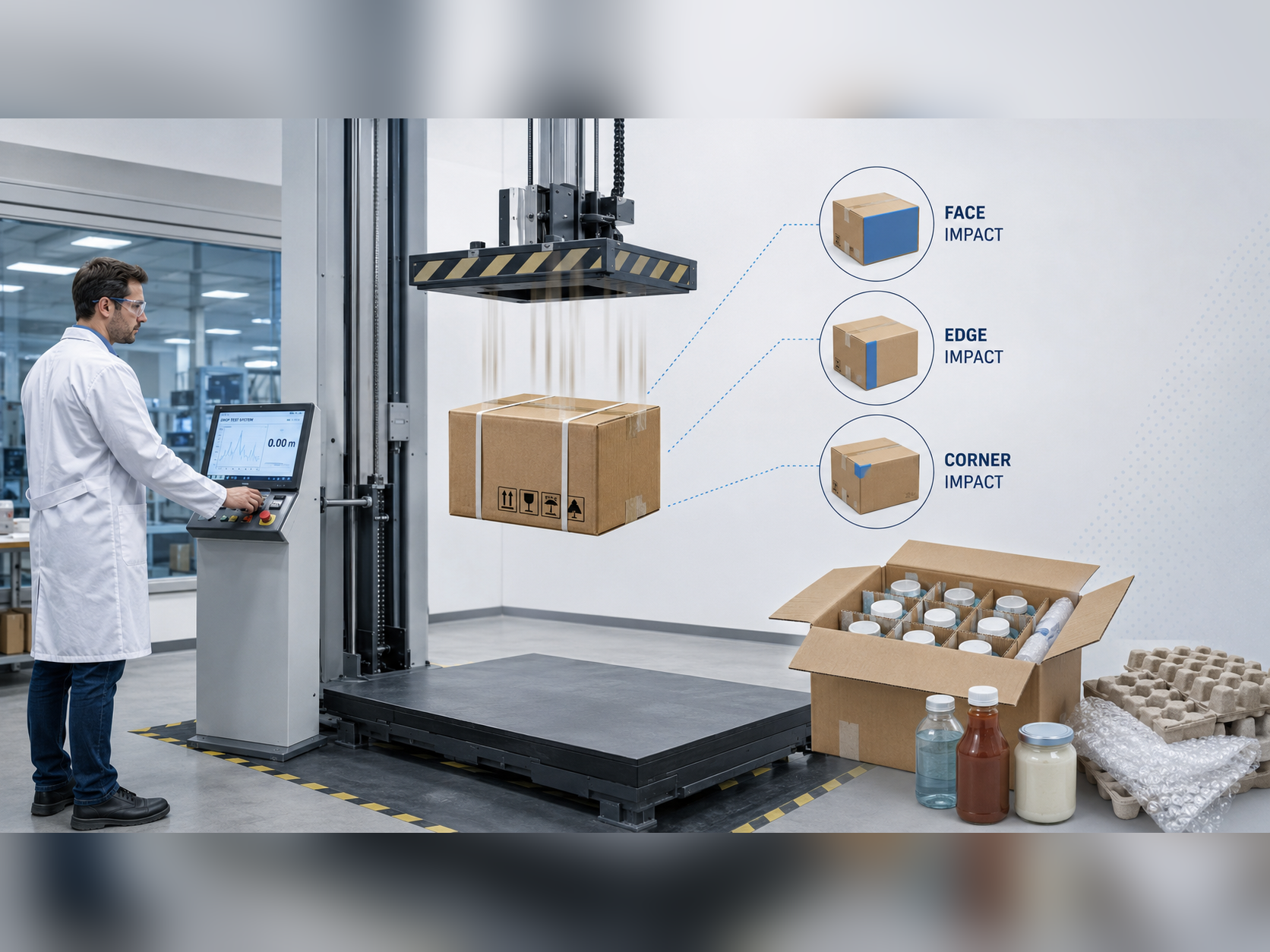
A crushed corner is easy to photograph. The harder question is whether it signals a cosmetic issue, failed closure, leaking primary package, or product failure later in distribution.
A box drop test evaluates how the complete packaged product performs during impact and helps identify potential failures before distribution.
What a Box Drop Test Evaluates
Four principles are easy to miss in a written procedure:
test the complete loaded package, not an empty shipping case;
obtain the height from the approved test plan rather than treating ASTM D5276 as one universal height table;
control and document face, edge, and corner impacts;
inspect the shipping case, interior packaging, primary pack, closures, labels, and product before deciding whether to pass or fail.
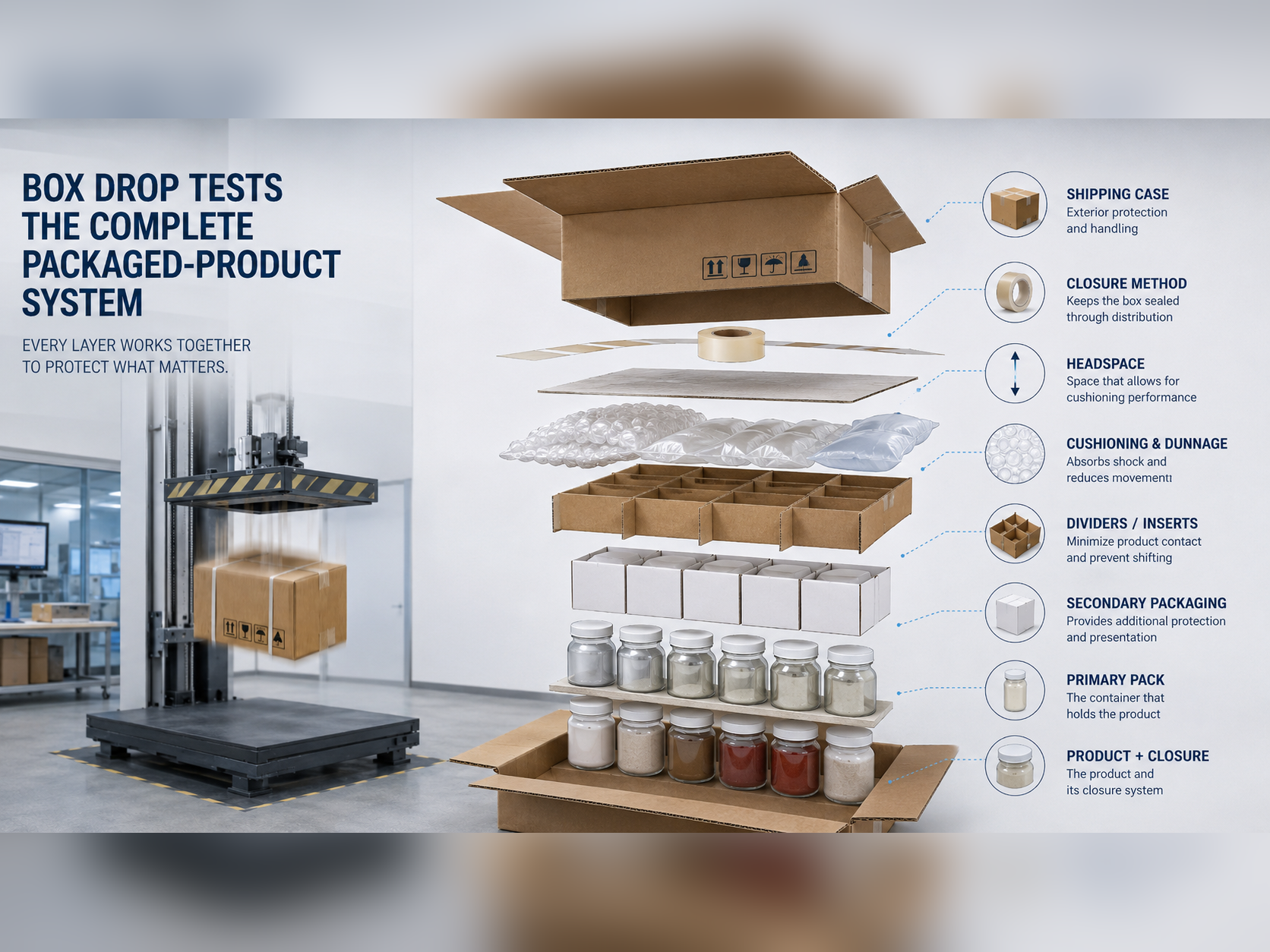
A Box Drop Test Evaluates the Packaged-Product System
ASTM D5276 covers free-fall testing of loaded boxes, cylindrical containers, bags, and sacks. Its purpose includes evaluating impact resistance, content protection, alternative designs, and progressive failure.
In CPG operations, shipping case means the corrugated transport case; shipping container is the broader ASTM term. The loaded package includes:
product, fill level, primary pack, and closures;
secondary packaging, dividers, cushioning, and dunnage;
the shipping case, headspace, closure method, and any overbox.
An empty case cannot reveal leakage, breakage, label abrasion, closure movement, or excessive product motion in the commercial pack.
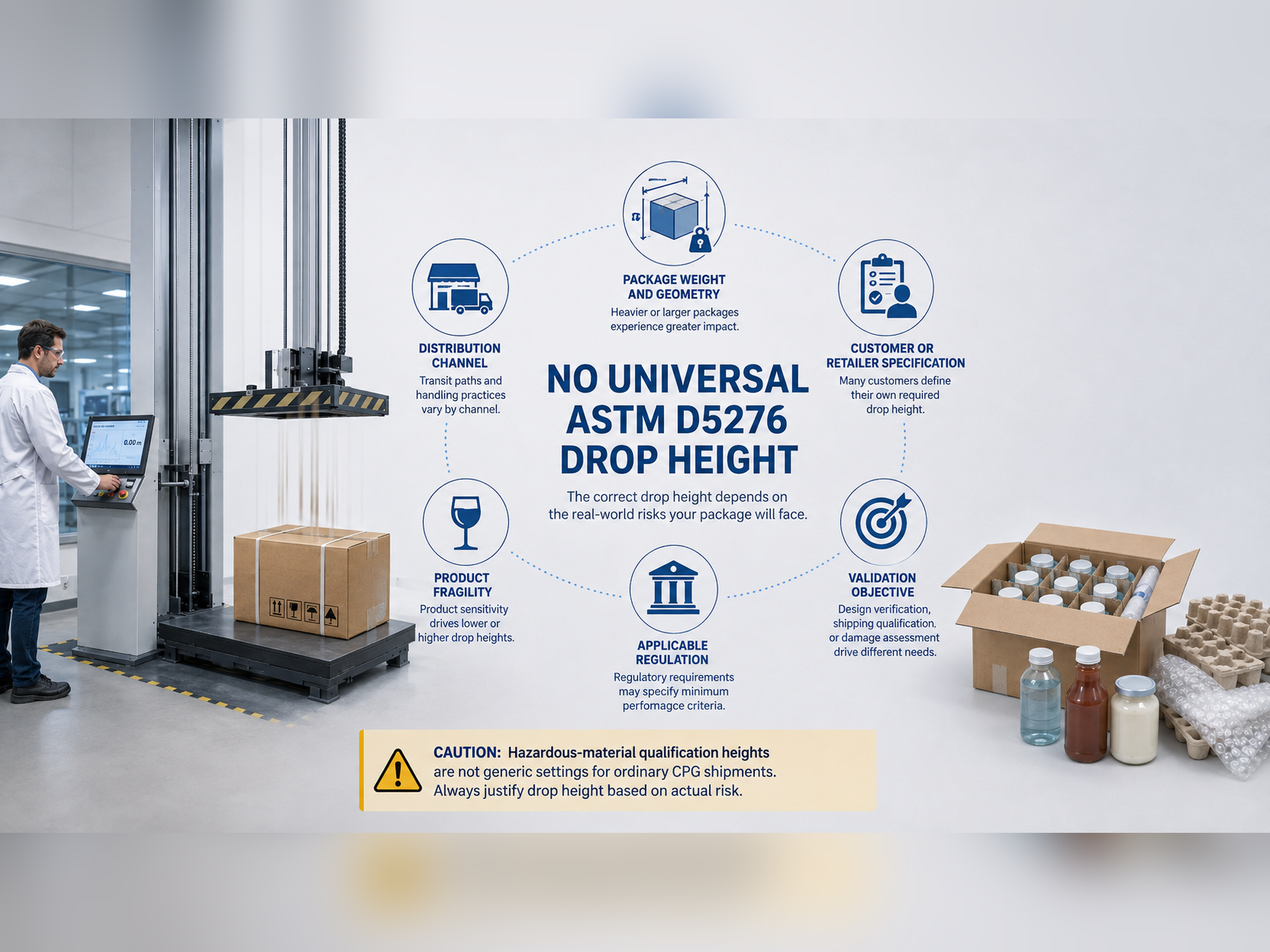
ASTM D5276 Drop Height: Why There Is No Universal Number
ASTM D5276 does not specify one universal drop height.
The official ASTM scope defines a repeatable free-fall test method and points users to ASTM D4169 for additional distribution guidance. The test height must come from the governing test plan: the distribution channel, package weight and geometry, customer or retailer specification, product fragility, validation objective, or applicable regulation. A height copied from another product can create a test that is either too weak to reveal risk or so severe that it drives unnecessary material into the package.
Before testing, document the standard and revision, source of the height, orientations and sequence, sample plan, and product-damage and package-degradation limits.
Do not borrow hazardous-material heights for ordinary CPG shipments. For regulated dangerous-goods packaging, 49 CFR §178.603 defines orientations, heights, and pass criteria. In several cases, it uses 1.8, 1.2, or 0.8 meters by Packing Group. Those are regulatory qualification requirements, not generic non-hazardous test settings.
Which Packaging Drop Test Standards Apply?
The right standard depends on the route to market and the decision the test must support.
Standard or protocol | Best fit | What it adds |
|---|---|---|
Isolated free-fall testing of loaded, manually handled containers | A repeatable drop method for evaluation and design comparison | |
U.S. single-parcel packages up to 150 lb (68 kg) | A sequence of distribution hazards for parcel shipments | |
Broader shipping-unit distribution cycles | Sequential performance testing at representative hazard levels; it directs single-parcel users to D7386 | |
North American parcel-delivery packages up to 150 lb (70 kg) | General simulation for standard, small, flat, and elongated packages, including multiple transport hazards | |
International vertical-impact method | A free-fall method with predetermined atmosphere, height, and package attitude; ISO reconfirmed it in 2022 | |
U.S. hazardous-material packaging qualification | Legally defined orientations, minimum heights, and pass criteria for covered packaging |
A standalone box drop test is useful for evaluating impact performance. ASTM D4169, ASTM D7386, and ISTA 3-Series use sequences because conditioning, vibration, compression, or earlier impacts may weaken a package. Retailer or carrier requirements may also take precedence.
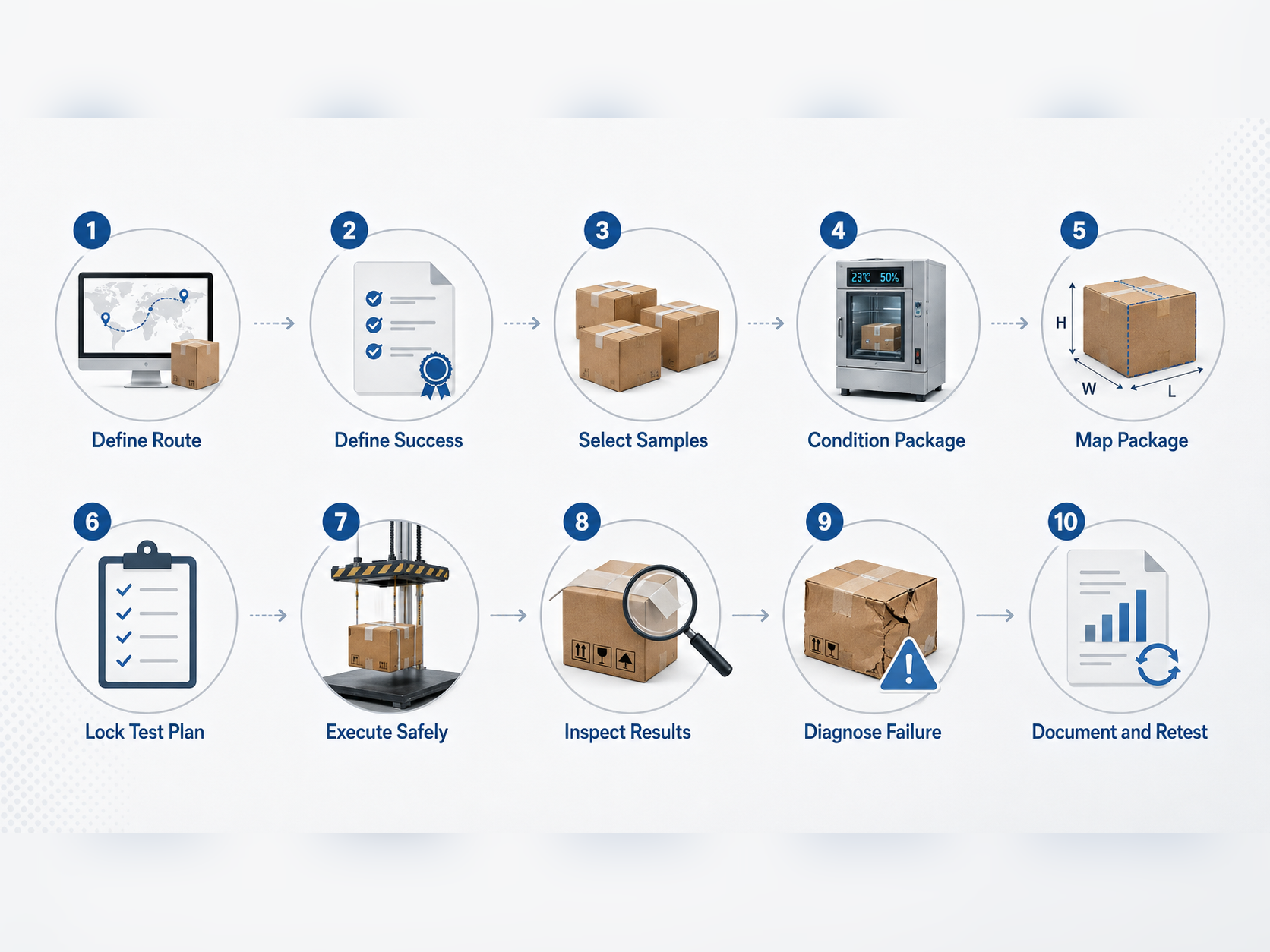
Packaging Drop Test Procedure: A Practical Workflow
The following packaging drop test procedure can be used with the applicable ASTM, ISTA, retailer, or regulatory requirements.
Define the distribution route
Specify parcel, e-commerce, truckload, distribution-center-to-store, or another route, including handling, climate, altitude, and retailer requirements.
Define success before the test
Set measurable product-damage and package-degradation limits before seeing results. ISTA advises documenting these criteria and the final pass/fail decision.
Select representative samples
Use production-intent components, fill, closures, and packing methods. Avoid previously shipped or tested samples; record lots and specifications.
Condition the package
Temperature and humidity can change packaging performance, especially for cellulosic materials. ASTM D4332-22 defines standard and special conditioning atmospheres for reproducible tests or particular distribution phases.
Map the package
Identify faces, edges, corners, seams, closures, and weak points. Use one orientation diagram across the protocol, worksheet, and report.
Lock the test plan
Record the revision, height, orientations, sequence, sample count, conditioning, apparatus, impact surface, and deviations. Obtain approval when the plan is contractual or regulatory.
Execute safely and consistently
Use calibrated equipment and a controlled release. Capture actual height, orientation, unintended secondary impacts, and images when practical.
Inspect against predetermined criteria
Inspect the case, interior packaging, primary pack, closures, labels, and product. Functional testing may be needed even without visible damage.
Diagnose the failure mechanism
Separate cosmetic damage from leakage, product failure, closure movement, cushioning bottom-out, or repeated-impact degradation. Identify what caused the failure before changing the package design or adding material.
Document, decide, and retest
Report traceability, conditions, results, images, deviations, and disposition. Retest after meaningful product, package, supplier, material, closure, pack-out, or process changes. Compare laboratory results with field performance.
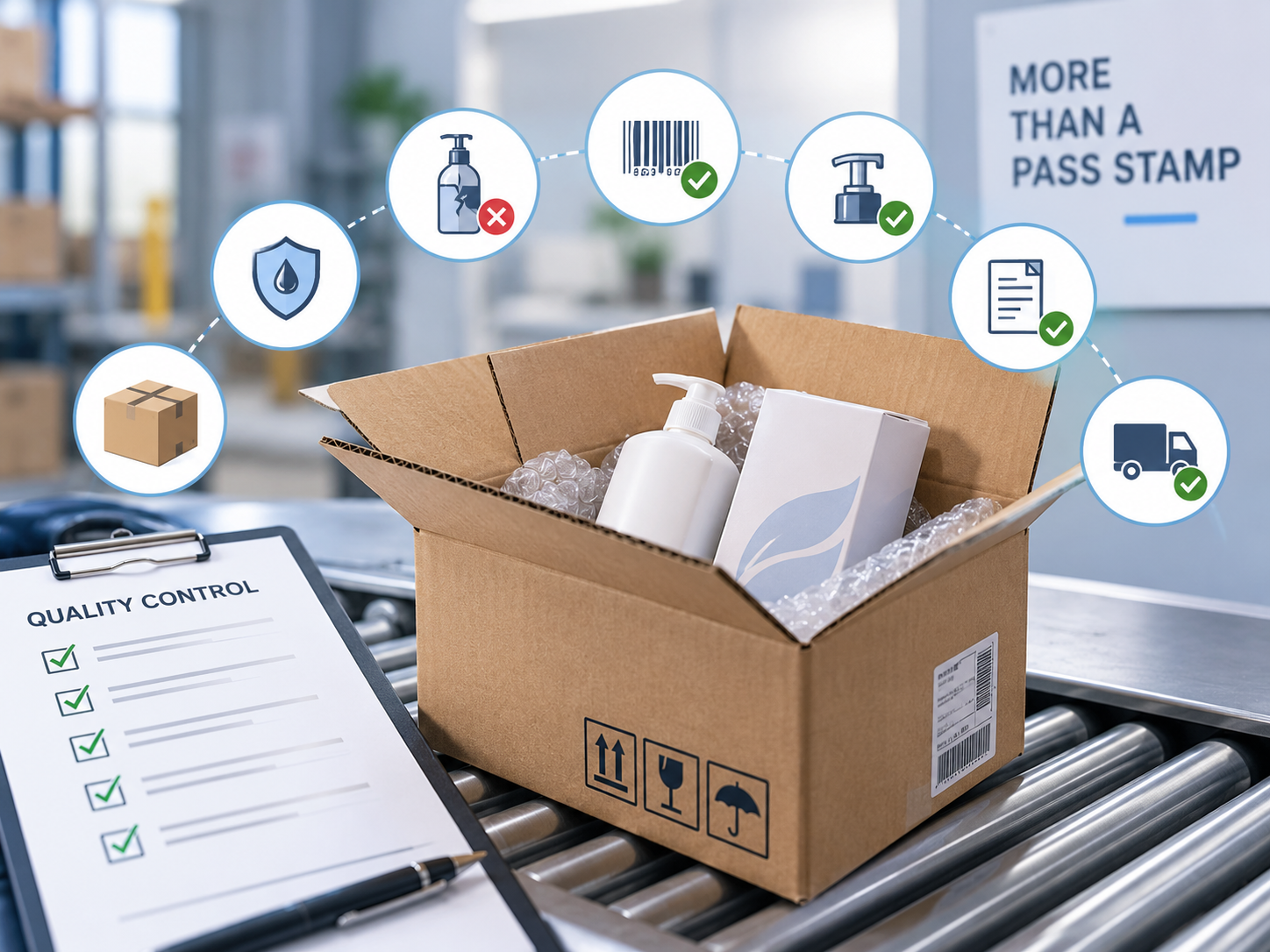
Packaging Quality Control Needs More Than a Pass Stamp
A “pass” is only useful when the failure definition reflects the business risk. For a CPG product, acceptance criteria may include:
no loss of product containment or leakage;
no broken, chipped, cracked, or functionally damaged primary package;
closures, pumps, seals, and tamper-evident features remain functional;
product performance remains within specification;
barcode, label, lot code, and required information remain readable;
damage does not make the unit unacceptable for retail or consumer delivery;
the shipping case retains enough integrity for the remaining distribution cycle.
Criteria must reflect the channel and product. A corner crush might be acceptable on a concealed shipper but not on shelf-ready packaging; an intact outer box can still hide a loose closure or abrasion.
Packaging Quality Control Checklist
Use this packaging quality control checklist at design validation, launch, change control, and periodic verification:
Distribution route and customer requirements are current.
Standard, protocol, and revision are identified.
Drop height and orientation source are documented.
Product and package samples represent commercial production.
Board grade, flute, dimensions, coatings, inserts, and cushioning match specification.
Tape, adhesive, staples, seals, and closure application match the approved process.
Conditioning requirements and actual conditions are recorded.
Equipment status, calibration, and impact surface are verified.
Product-damage tolerance and package-degradation allowance are approved before testing.
Every drop, orientation, result, and deviation is traceable.
The outer case, interior packaging, primary package, closures, labels, and product are inspected.
Failures receive root-cause analysis and corrective action.
Retest triggers cover material, supplier, product, pack-out, and process changes.
Field damage, returns, leakage, and customer complaints are compared with laboratory results.
What This Means for CPG Leaders
First, qualify packages by route to market. Retail, direct-to-consumer, and marketplace shipments may need different protocols for the same SKU.
Second, connect testing to change control. A launch test cannot cover later lightweighting, supplier, closure, pack-count, or automation changes.
Third, optimize total cost. Strong packaging quality control should reduce product damage without defaulting to overpackaging. ISTA says predictive testing can balance package cost, damage cost, and environmental impact when laboratory tests relate meaningfully to field performance.
A good box drop test shows whether the package can protect the product through its expected distribution conditions and where the design may need improvement.
Frequently Asked Questions
What is a package drop test?
A package drop test releases a filled shipping unit onto a defined impact surface from a controlled height and orientation. The selected standard or protocol determines the method, sequence, and acceptance criteria.
What is the correct ASTM D5276 drop height?
There is no single height for every package. Select the height from the governing distribution test plan, customer specification, product requirement, or regulation. Record the source rather than citing ASTM D5276 alone as the reason for a number.
How many times should a box be dropped?
The governing development, ASTM, ISTA, retailer, or hazardous-material plan determines samples and orientations. Do not substitute an informal “ten-drop test” for the current document.
Does passing ASTM D5276 certify a package for parcel delivery?
Not by itself. ASTM D5276 is a free-fall test method. For a U.S. single-parcel distribution sequence, evaluate the current ASTM D7386, ISTA 3A, retailer or carrier program, and any contractual requirements that apply.