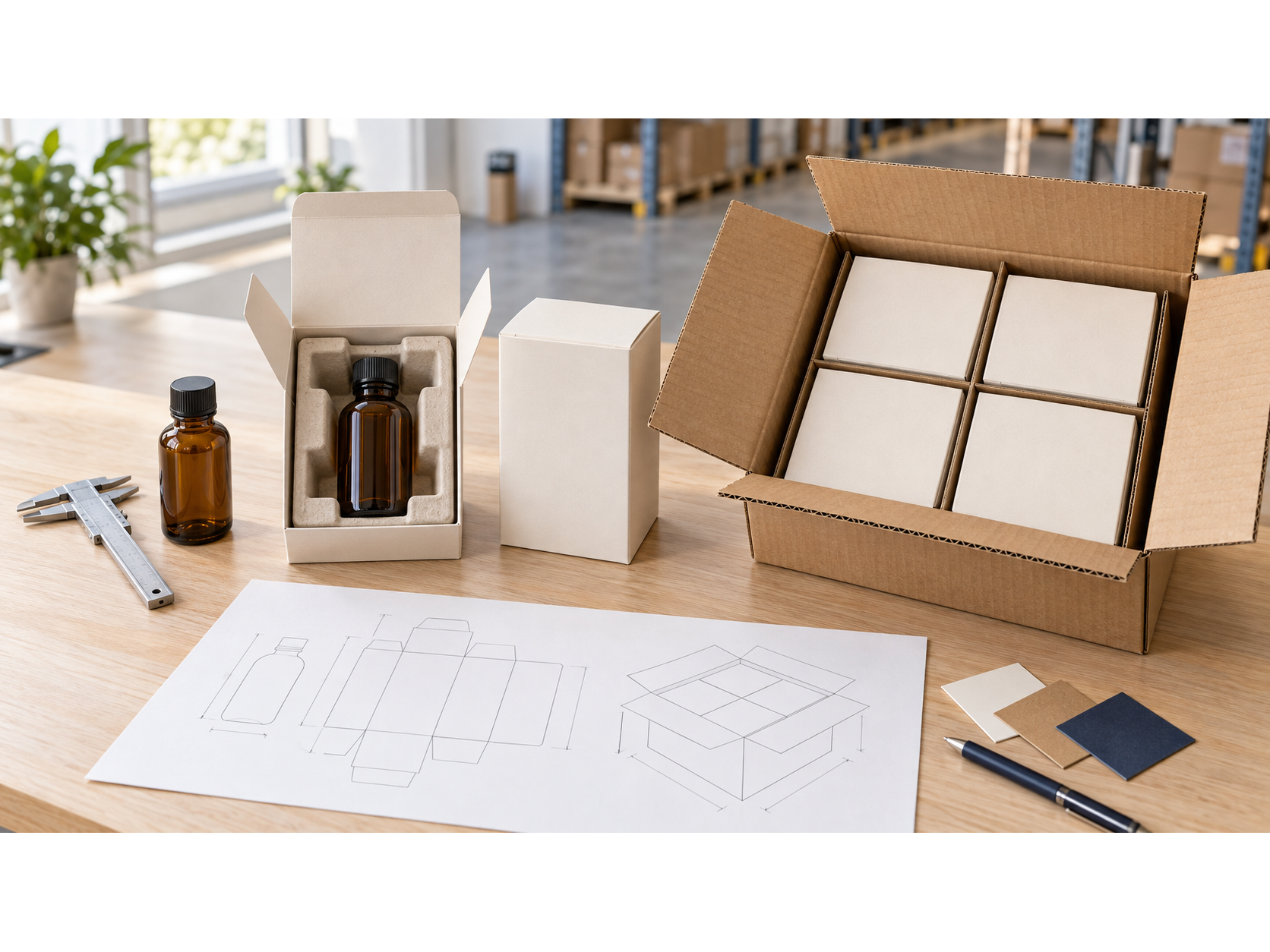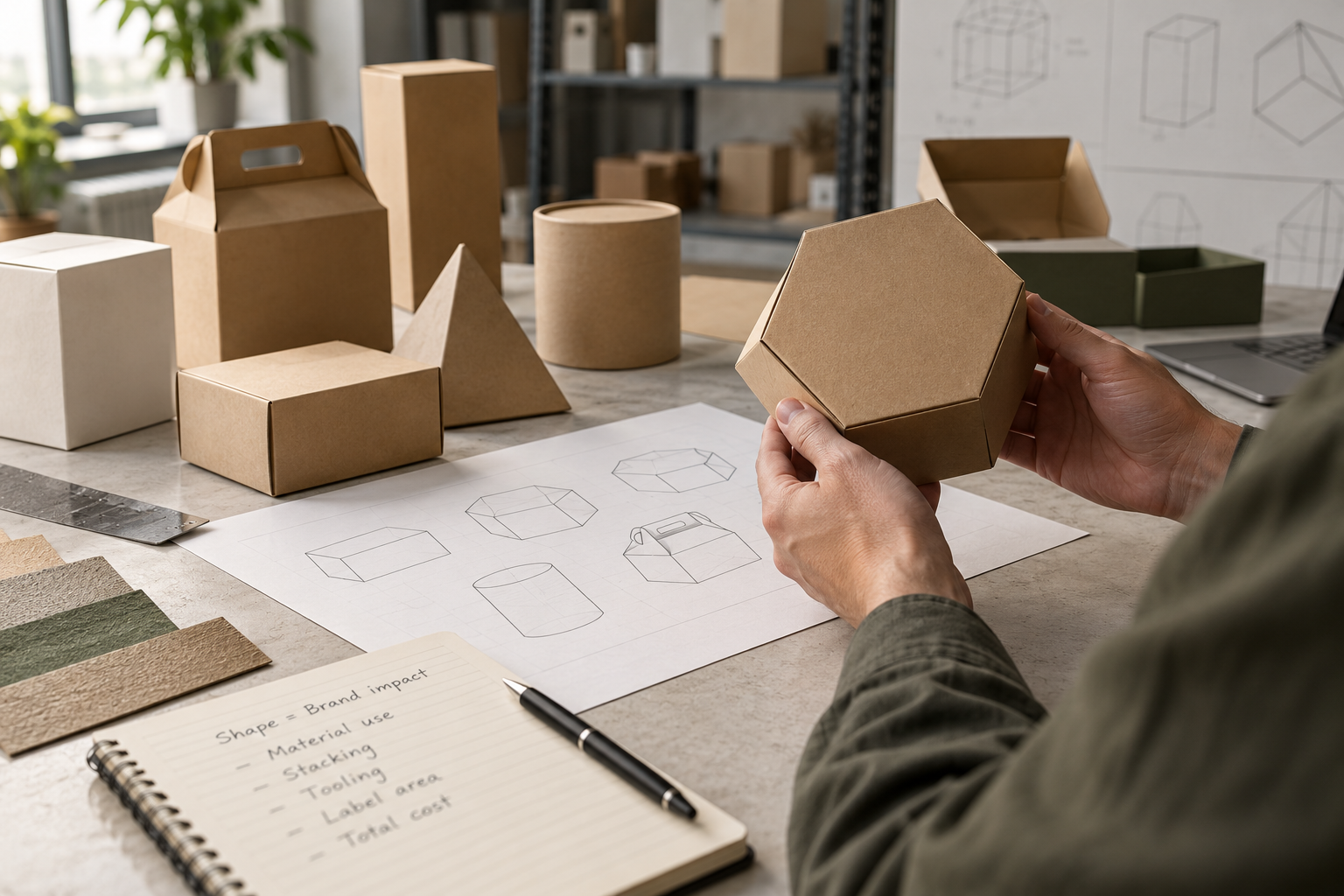
Choosing a box shape looks like a design decision and behaves like an operations decision. A hexagonal carton gets picked up off a shelf. It also costs more board per unit, does not stack, needs its own tooling, and leaves you six narrow panels to fit an ingredient list onto.
None of that makes it the wrong call. It makes it a decision with a price, and the price is usually paid by people who were not in the room when the shape was chosen.
Box Shape and Box Style Are Different Decisions
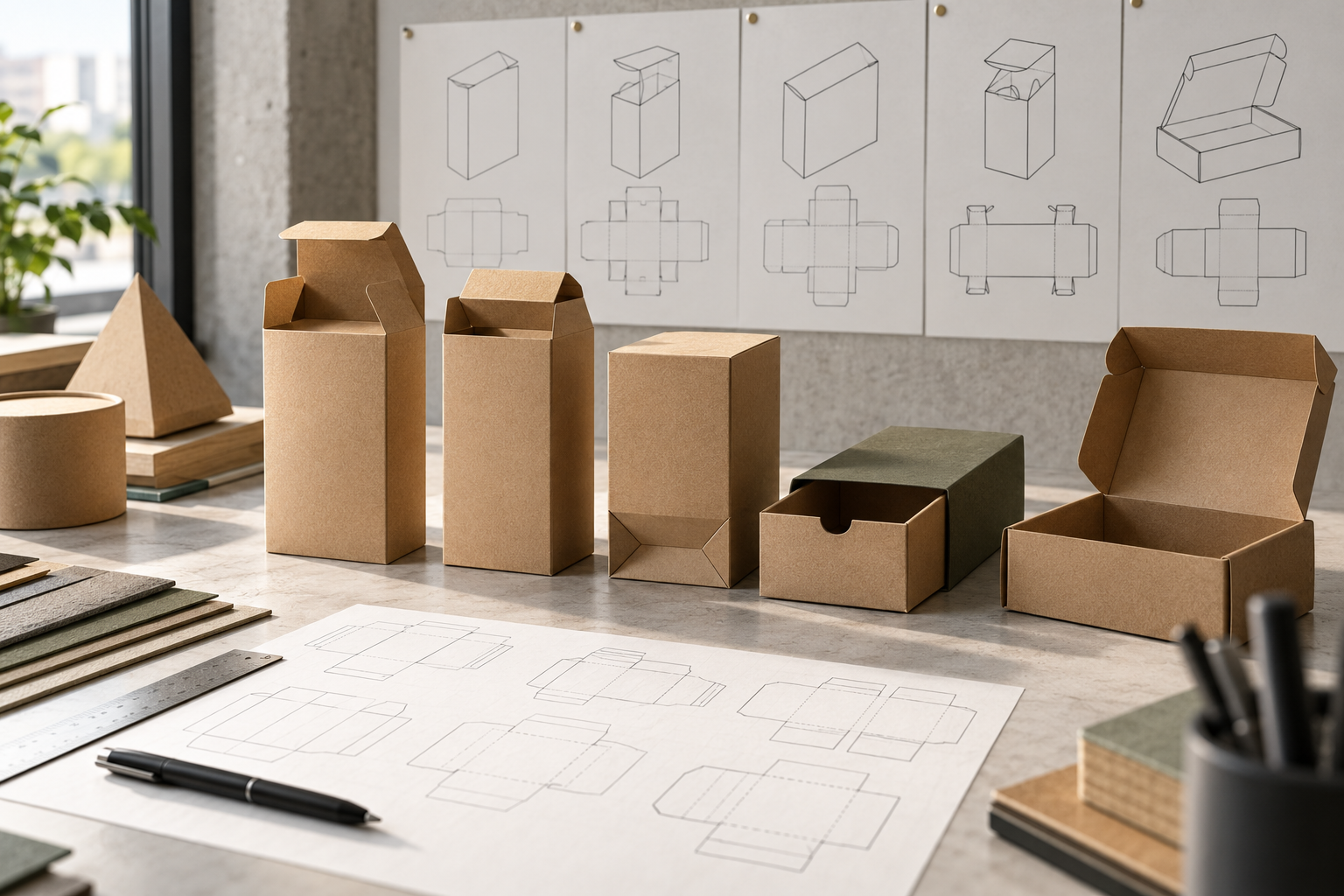
Shape is the silhouette: rectangular, cylindrical, triangular, polygonal, curved. Style is how it is built: tuck ends, automatic bottom, sleeve and drawer, regular slotted case, mailer, telescope.
One rectangular carton can be any of four styles, and those four erect differently, fill differently, cost differently and run at different speeds on a line. Ask for "a rectangular box" and you will get four quotes that are not comparable.
Both have catalogues. FEFCO numbers the standard corrugated designs, ECMA does the same for folding cartons, and quoting a code number is the fastest way to make sure everyone is pricing the same box. A custom dieline can start from one of those and modify it, but production runs off the approved drawing, not off whatever the structure gets called in a deck.
Eight Box Shapes Commonly Used in Packaging
Box shape | Where it often fits | Principal advantages | What it costs you |
|---|---|---|---|
Rectangular or cuboid | Food, beauty, personal care, retail cartons, shipping cases | Flat panels support graphics, stacking, coding, and automation | Nothing unusual. This is the baseline everything else gets compared against |
Square | Jars, confectionery, kits, premium products | Symmetrical footprint and visual balance | A square footprint often wastes shipping-case space that a rectangle would have used |
Flat or low-profile | Subscription packs, apparel, printed kits, frozen foods, slim products | Low depth can reduce empty space and present a broad top panel | Large unsupported panels bend, and edges take the hit in a parcel network |
Tall and narrow | Bottles, tubes, personal care, spirits, slender devices | Creates a vertical billboard and follows an upright product | High center of gravity, so it tips on shelf and buckles under stacking |
Cylindrical or tube | Powders, confectionery, gifting, specialty beauty | Distinct silhouette and continuous display surface | It rolls, it does not tessellate on a pallet, and the barcode curves away from the scanner |
Gable or peaked | Bakery, foodservice, gifting, meal kits, selected beverage cartons | Recognizable silhouette; the top can integrate a closure or handle | The peak is air in every shipping case, and the top usually needs a hand to close it |
Triangular, wedge, or pyramidal | Confectionery, cheese, gifts, promotions, products with matching geometry | Strong differentiation and product-specific storytelling | Worst board yield of the eight, and only one or two faces can carry real copy |
Hexagonal, octagonal, or polygonal | Cosmetics, fragrance, confectionery, premium gifts | Multiple facets create a distinctive reveal | Every extra facet is another score to keep aligned, and narrow faces fragment your copy |
Pillow or curved carton | Small accessories, samples, confectionery, cosmetics, lightweight gifts | Curved end panels create a soft silhouette from one folding-carton blank | Curved ends do not stack, and the flat graphic area is smaller than it looks on screen |
Two boxes can share a shape name and behave nothing alike. Proportions do most of the work: a tall narrow rectangle and a flat wide one are both rectangular, and one of them stacks while the other bends.
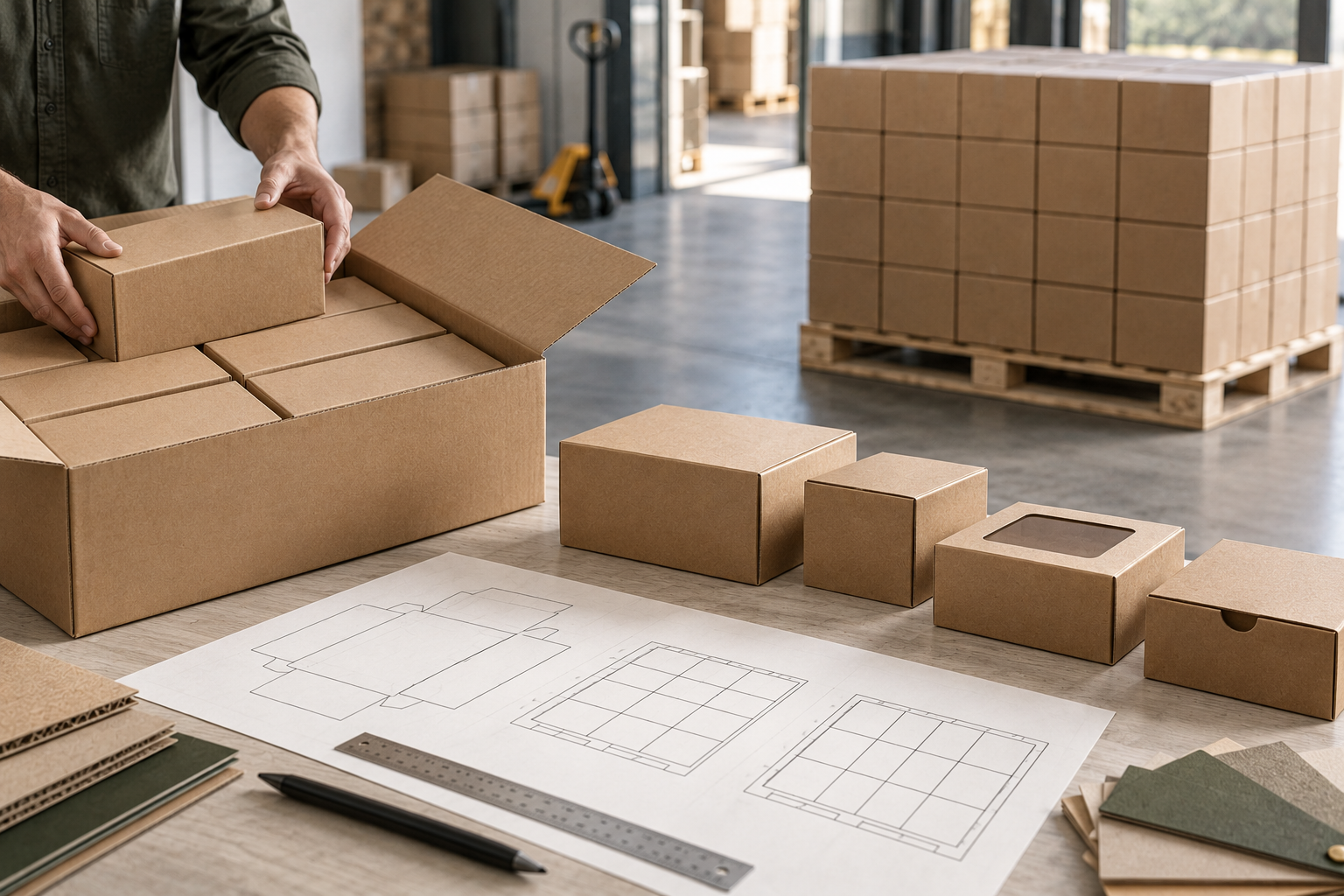
Rectangular Boxes Remain the Operational Baseline
A rectangle is the only shape that tessellates in every direction. It fills a shipping case with no gaps, it builds a pallet layer with no gaps, and it cuts out of a flat sheet with almost no waste. Every other shape on the list gives up some of that.
A rectangle tessellates in every direction. It fills a shipping case and builds a pallet layer without gaps, and it cuts from a flat sheet efficiently. Other shapes give up some of that.
Differentiation still has room inside that footprint: panel proportions, the order things open in, a window, an insert, a finish.
Square is worth checking rather than assuming. Efficiency comes from how the carton divides into the shipping case and the pallet layer, not from whether two of its dimensions match. A square that does not divide evenly into a 48 by 40 pallet leaves dead space, the same as any other shape that does not.
What a rectangle costs you
It costs you recognition. On a shelf where every competitor is also rectangular, the shape is doing nothing for you, and everything has to come from the print. For a brand fighting for a second look in a crowded category, that is a real cost, and it is the reason non-rectangular shapes exist at all.
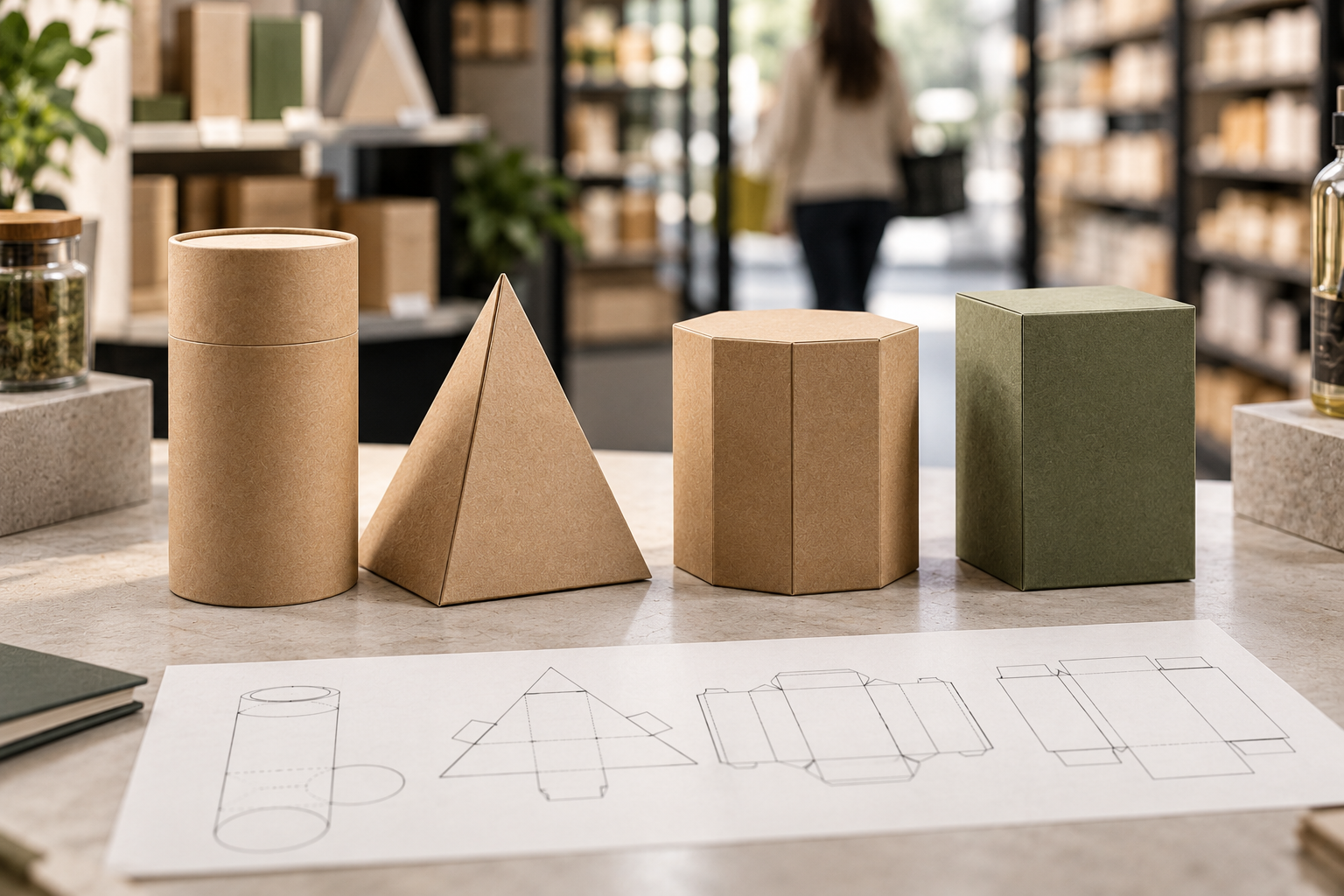
Curves and Facets Trade Efficiency for Experience
Cylinders, triangles and polygons buy you a silhouette someone can recognize across an aisle. What they cost varies by design, but it comes from the same places every time: more board per unit, a custom die, more glue seams, sometimes handwork, and void space in whatever ships them.
On a curved surface the artwork wraps out of view, and so does the barcode. GS1 has placement rules for exactly this, because curvature can hide the ends of a symbol from a scanner, and a code that verifies flat on a proof can fail on the finished tube.
More facets also means less usable copy space, not more. Eight narrow faces sound like eight panels and function like none of them, because an ingredient list that has to break across three facets is a list nobody reads.
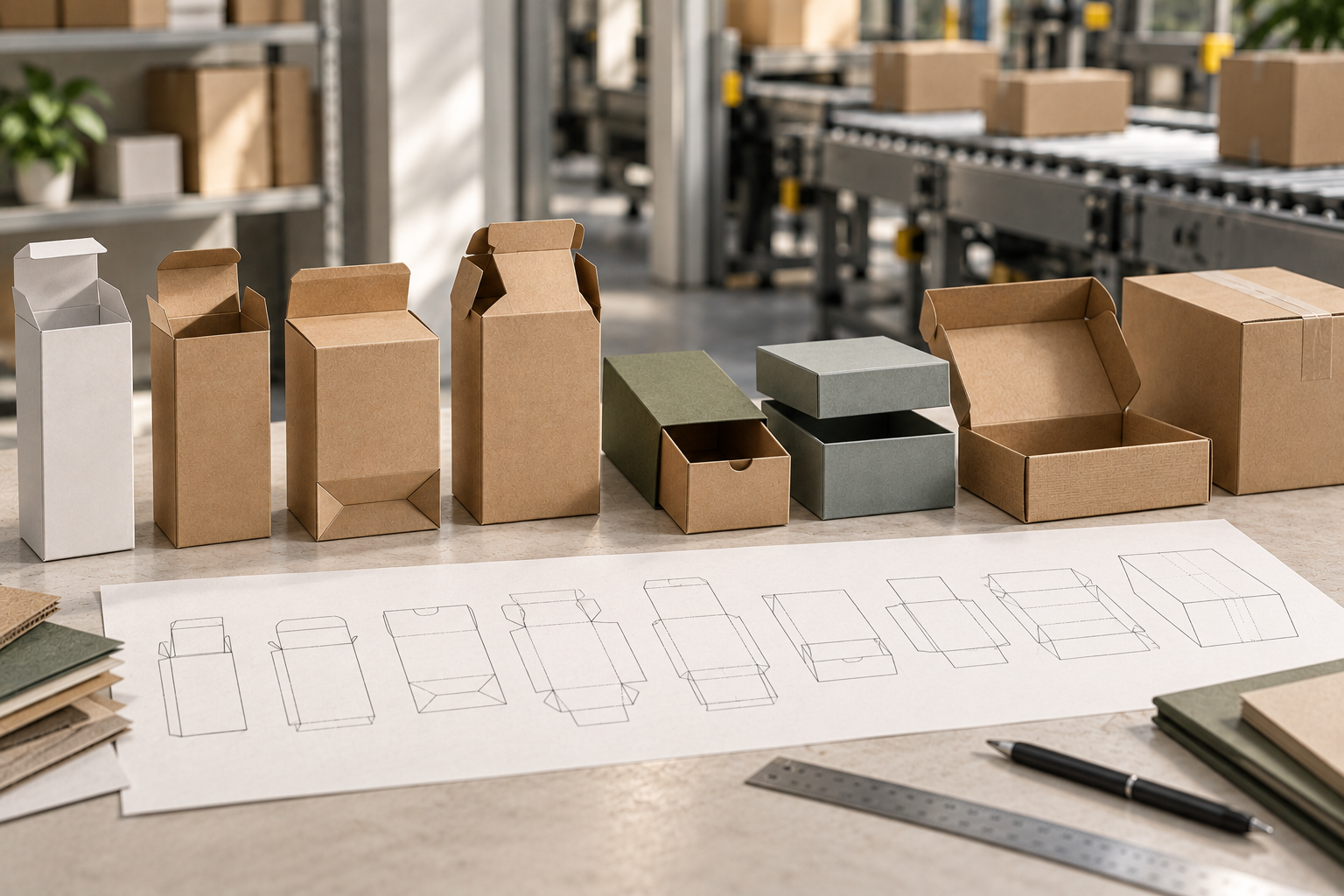
Closure Style Changes the Consumer and Production Experience
Once the geometry is settled, the structure decides how the box gets put together and how it comes apart. Reverse tuck is the cheapest and the flaps are visible from the back. Straight tuck hides them and costs a little more board. An automatic bottom pops open and locks, which is what you want if a person is assembling hundreds by hand. Six-corner constructions hold heavier product without a separate tray.
Other common structures include:
Sleeve and drawer. A sliding reveal, and two components instead of one, which means two dielines, two print runs and an assembly step.
Two-piece or telescope. Base and lid. Rigid and presentable, and it ships as two pieces that have to be nested or assembled.
Mailer or roll-end. Hinged corrugated, ships flat, folds without tape. The default for e-commerce.
Regular slotted case. The standard shipping case with meeting flaps, and the cheapest corrugated structure there is.
Rigid set-up box. Pre-erected board wrapped in paper. It cannot fold flat, so it ships assembled and takes several times the warehouse space per unit.
A structure that opens beautifully still has to close reliably on a line and stay closed through a parcel network. Those are different problems, and an empty sample answers neither.
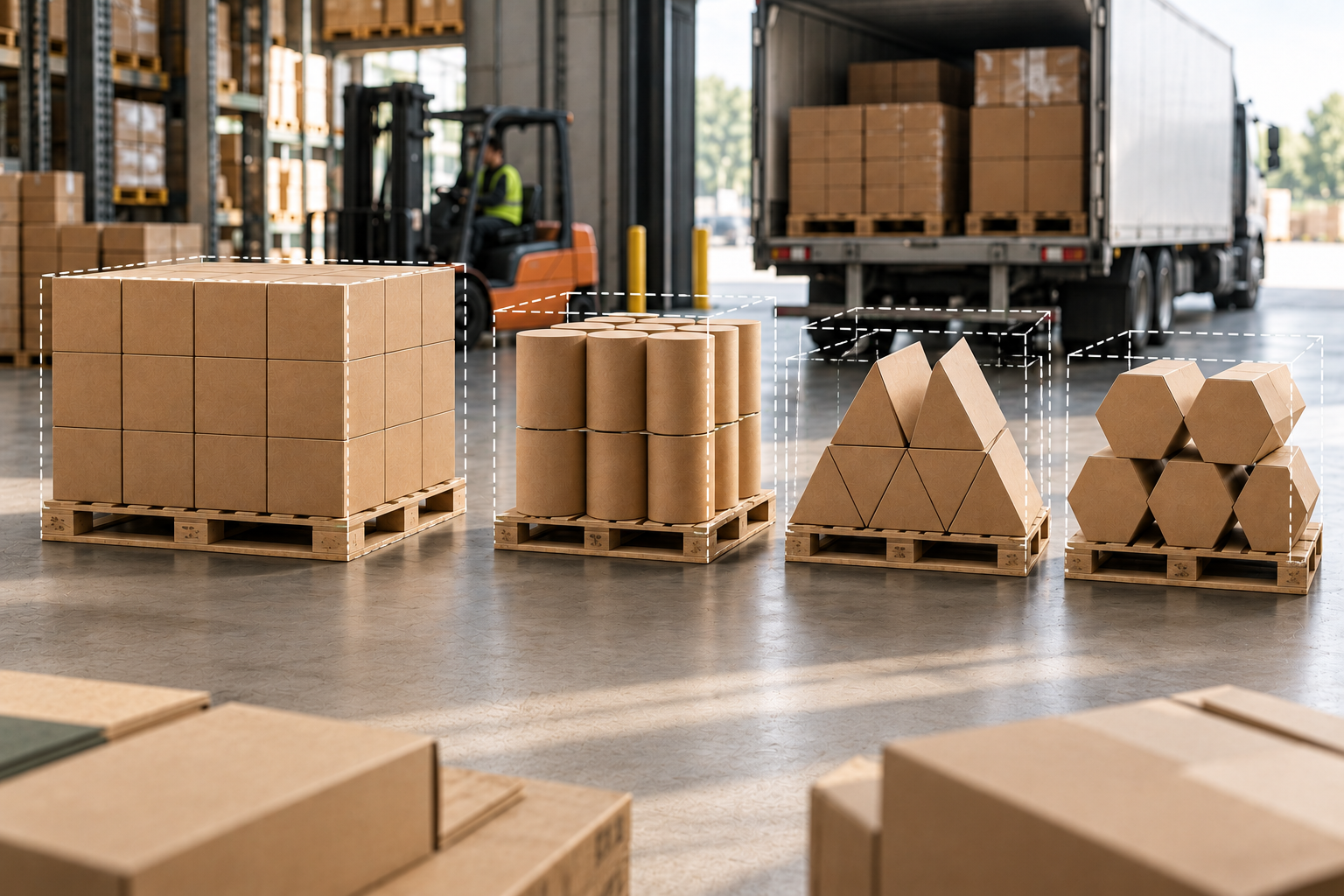
Shape Changes Freight and Distribution Performance
Empty space compounds. A shape that wastes a small amount of room in one carton wastes it again in every case, again on every pallet layer, and again on every truck, and by then it is not a small amount.
This is also where shape turns into money directly. U.S. parcel carriers (ex. Fedex) bill on actual weight or dimensional weight, whichever is greater, and dimensional weight is calculated from the box, not the contents. A light product in a tall or gabled box gets billed for the air.
Shape changes which test applies. ISTA 3A separates standard, small, flat and elongated parcels precisely because they fail differently: a flat package fails on the face, an elongated one fails on the ends. ASTM D642 covers compression on faces, edges and corners, and ASTM D4169 runs a broader sequence of distribution hazards. All of them run on a loaded package, not an empty one.
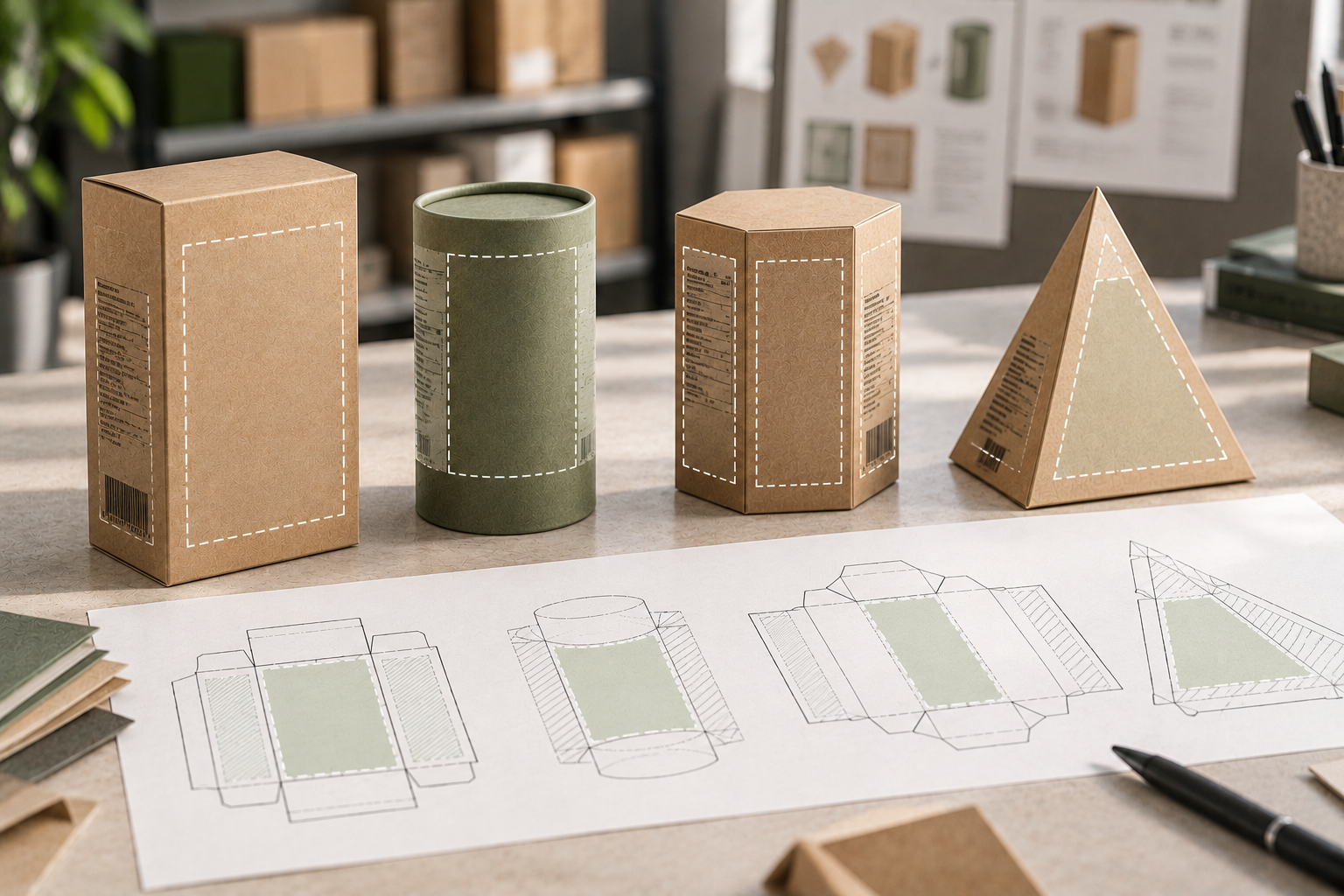
Shape Must Leave Room for Required Information
The shape usually gets picked before anyone counts how much text has to fit on it. On a regulated product that order does not work, because the copy is not negotiable and the geometry is.
For U.S. packaged food, 21 CFR 101.1 defines the principal display panel differently depending on the shape: it is a full face on a rectangular box, but on a cylinder it is 40% of the height times the circumference, and other shapes get their own calculation. Change the shape and you change how much area legally counts as your main panel.
A copy map before the dieline freezes is the cheapest version of this. It marks the principal display panel, the information panels, and everything that eats into them: seams, curves, glue areas, windows, coding zones, the barcode. Then it checks what is still visible on shelf and what is still visible after someone has opened the box, because a legal statement printed under a tear strip is not a legal statement anymore.
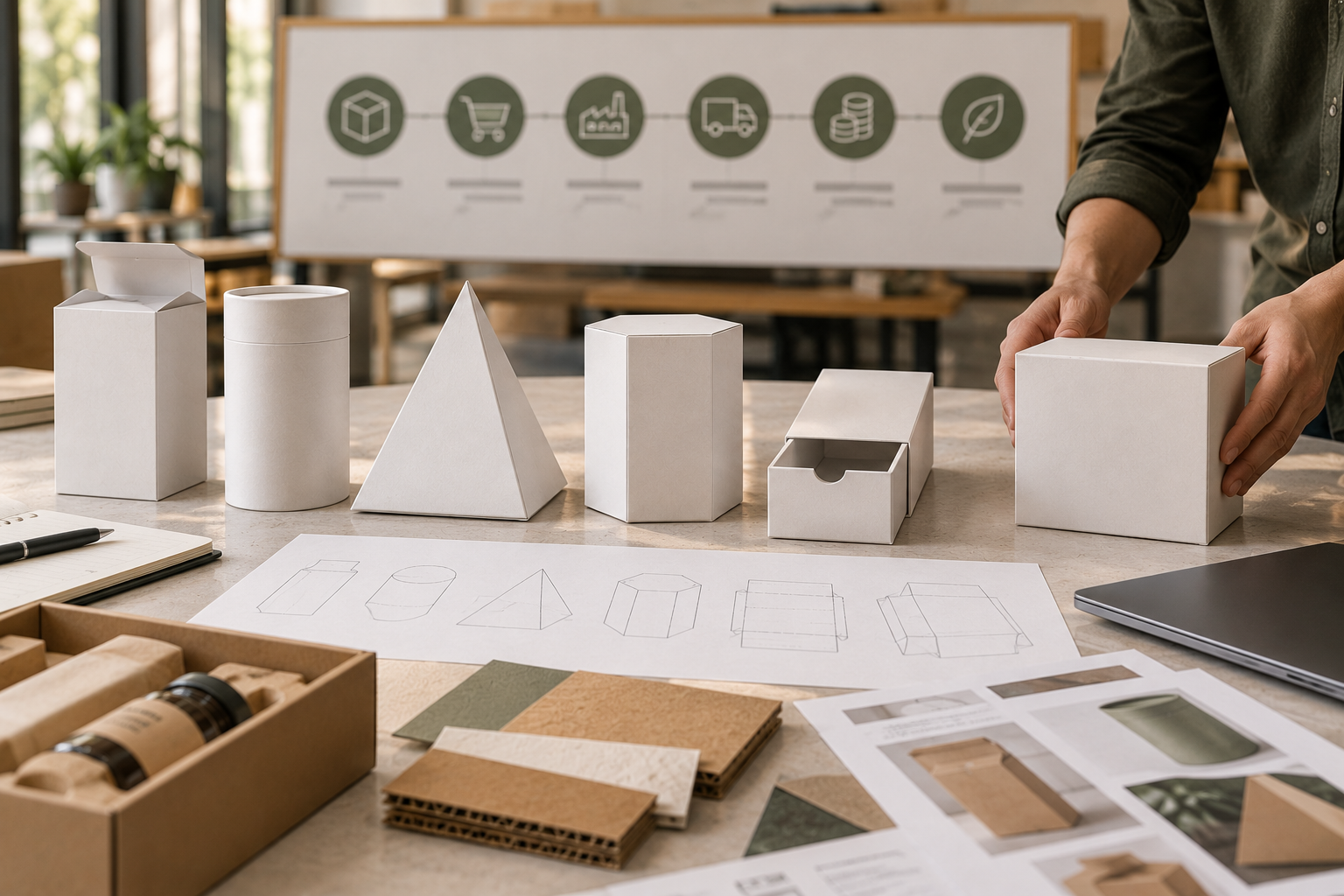
How to Choose Among Different Box Shapes
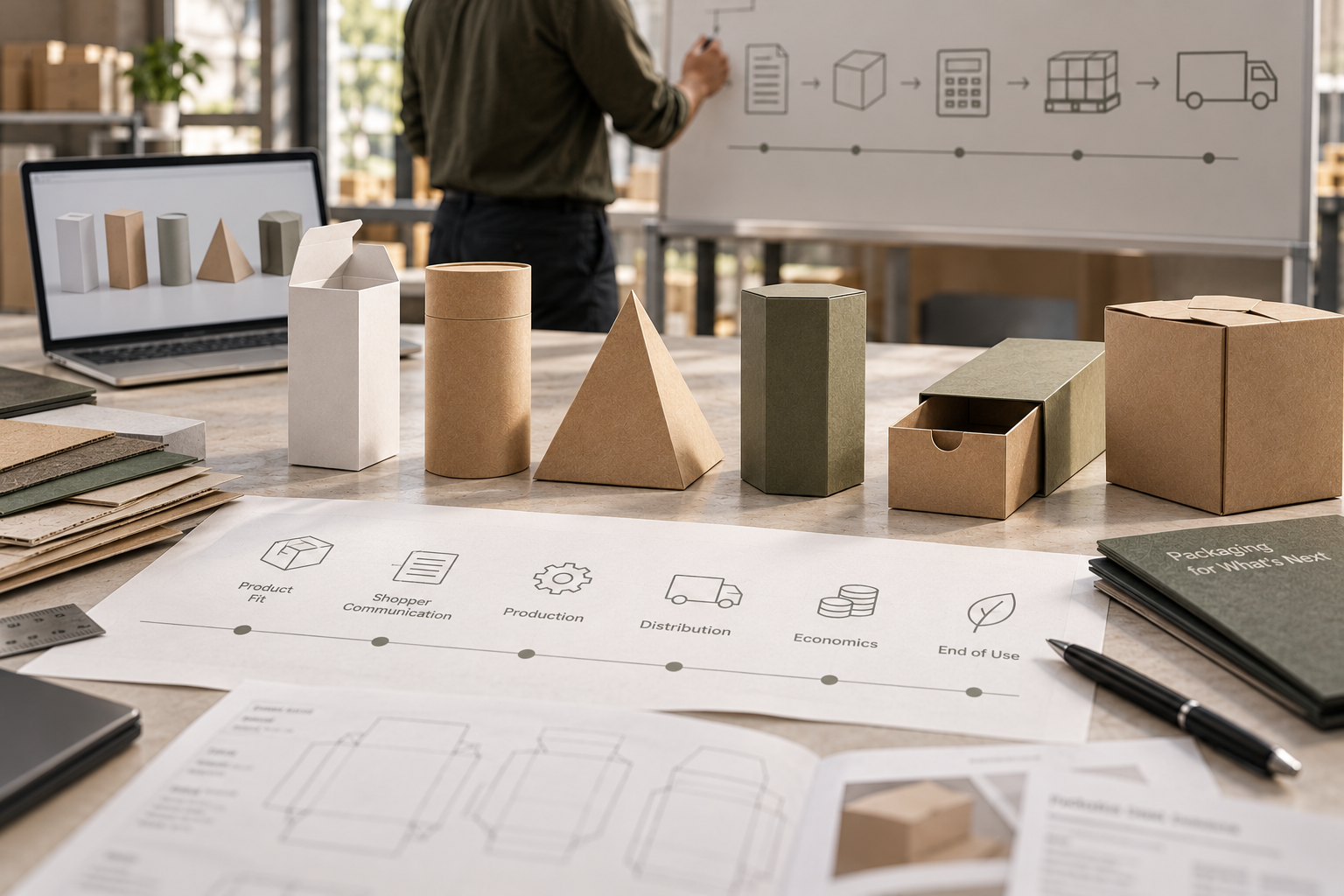
Score each candidate against the same six questions:
Product fit: Does the shape control movement, orientation, leakage, fragility, and access?
Shopper communication: Is the brand, product type, variant, and required information visible at shelf and thumbnail size?
Production: Can current or available equipment erect, fill, close, code, inspect, and pack it at the required rate?
Distribution: Does it use the shipping case and pallet efficiently and withstand the real route?
Economics: Board yield and tooling are the two that separate shapes most. A non-rectangular blank wastes sheet, and a custom shape needs a custom die that gets paid for once and used forever, or once and used once.
End of use: Can someone get the product out, close it again if they need to, and separate the components to dispose of them. A shape that needs three hands to reclose gets thrown away after one use.
Plain white samples first, all of them loaded with the same product, compared side by side. Then production-intent versions with the real material, graphics, inserts and closures. And the shape should be doing a job you can name. Distinctive geometry does not fix a proposition that was not clear to begin with.
Pick the Shape Last
Name what the shape has to do, map the copy that legally has to fit, then check what the geometry costs in board, in case fill, in pallet layers and in dimensional weight. Only then is it a shape decision rather than a rendering decision.
Different shapes buy different things. None of them is free, and the bill arrives somewhere downstream from whoever picked it.