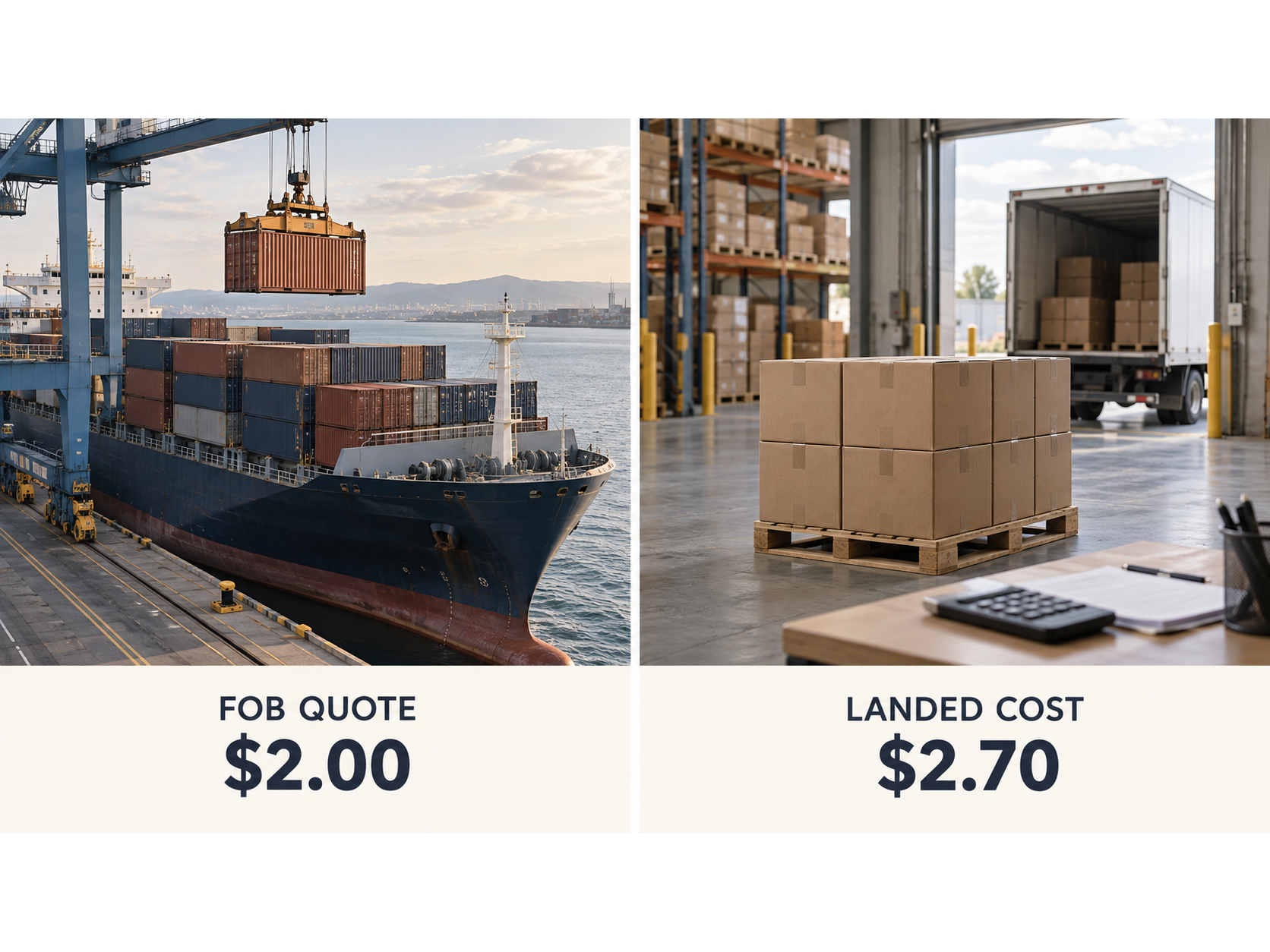
A $2.00 FOB quote can arrive at your warehouse costing $2.70. Nothing went wrong on the way. FOB and landed cost are answering two different questions, and only one of them is about what you pay.
FOB is a contract rule. It says where delivery happens, when risk transfers, and who handles which transport and customs obligations. Landed cost is a management number. It estimates what you spend to get the goods to a destination you choose.
Use FOB to write the contract. Use landed cost to compare suppliers, set margins and build budgets. Confusing the two is how a sourcing decision gets made on the wrong number.
FOB and Landed Cost Are Not Competing Trade Terms
Question | FOB | Landed cost |
|---|---|---|
What is it? | An Incoterms® rule for a sales contract | A buyer-defined cost metric |
What does it define? | Delivery, risk transfer, and specified seller/buyer obligations | Costs included through a stated destination |
Where is the endpoint? | On board the nominated vessel at the named port of shipment | A location the buyer chooses, usually a U.S. warehouse or third-party logistics facility (3PL) |
What is it used for? | Contracting and shipment responsibility | Sourcing, pricing, margin, and variance analysis |
Is the scope universal? | Standardized under the referenced Incoterms edition | No; the company must define included costs and endpoint |
"Landed price" is not a defined term. One supplier means delivered to a U.S. port. Another means cleared and delivered to your 3PL. The gap between those two is duty, brokerage, drayage and domestic freight, which on the example below is about $0.42 a unit. Two quotes using the same words can be $0.42 apart before anyone has misquoted anything.
What Does FOB Mean Under Incoterms® 2020?
Incoterms are a set of standard delivery rules published by the International Chamber of Commerce. They do one job: split the transport and customs responsibilities between buyer and seller, and fix the point where risk passes from one to the other. Naming the edition matters because the rules get revised, and FOB in the 2020 edition is not identical to FOB in earlier ones.
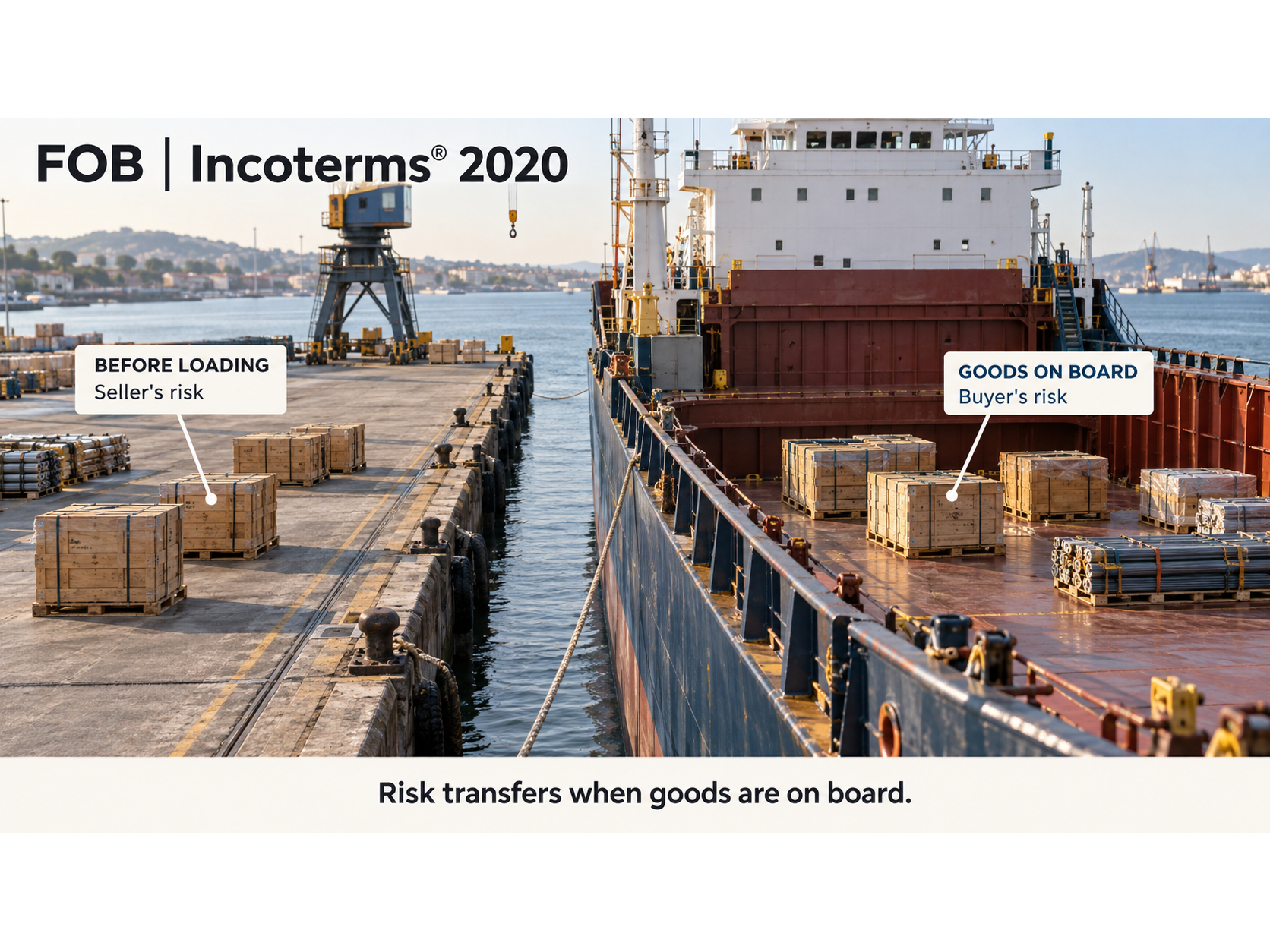
Under the ICC's FOB rule, the seller delivers the goods on board the vessel nominated by the buyer at the named port of shipment. Risk transfers when the goods are on board. The seller handles export clearance where applicable, while the seller has no obligation to clear the goods for U.S. import or pay U.S. import duty.
FOB is written for sea and inland-waterway transport, and it assumes the goods go over the ship's rail. Containerized cargo does not work that way. A container is handed to the carrier at a terminal days before it is loaded, which means under FOB the seller stays on risk for goods they no longer control. The ICC points to FCA for this situation, a rule where delivery happens when the container is handed over rather than when it is loaded.
Most CPG packaging moves in containers. Accepting FOB because the shipment is by sea is the most common version of this mistake.
FOB puts you in control of the ocean leg and on the hook for everything after loading. FCA moves the delivery point to where the container is actually handed over, which is what most containerized cargo needs. DDP puts everything on the seller including U.S. duty, which is convenient and means you cannot see what any of it costs.
Write the term precisely, for example, FOB Shanghai, Incoterms® 2020, and identify the agreed loading point if needed. “FOB China” does not identify a port and leaves an avoidable contract gap.
FOB does not settle title, payment timing, warranty remedies, or customs value. Those live elsewhere in the contract. It also does not require the seller to insure the main carriage, which means that between the port of loading and the U.S. destination the cargo is uninsured unless you bought cover. That is a decision, not a default.
When FOB is the right term anyway
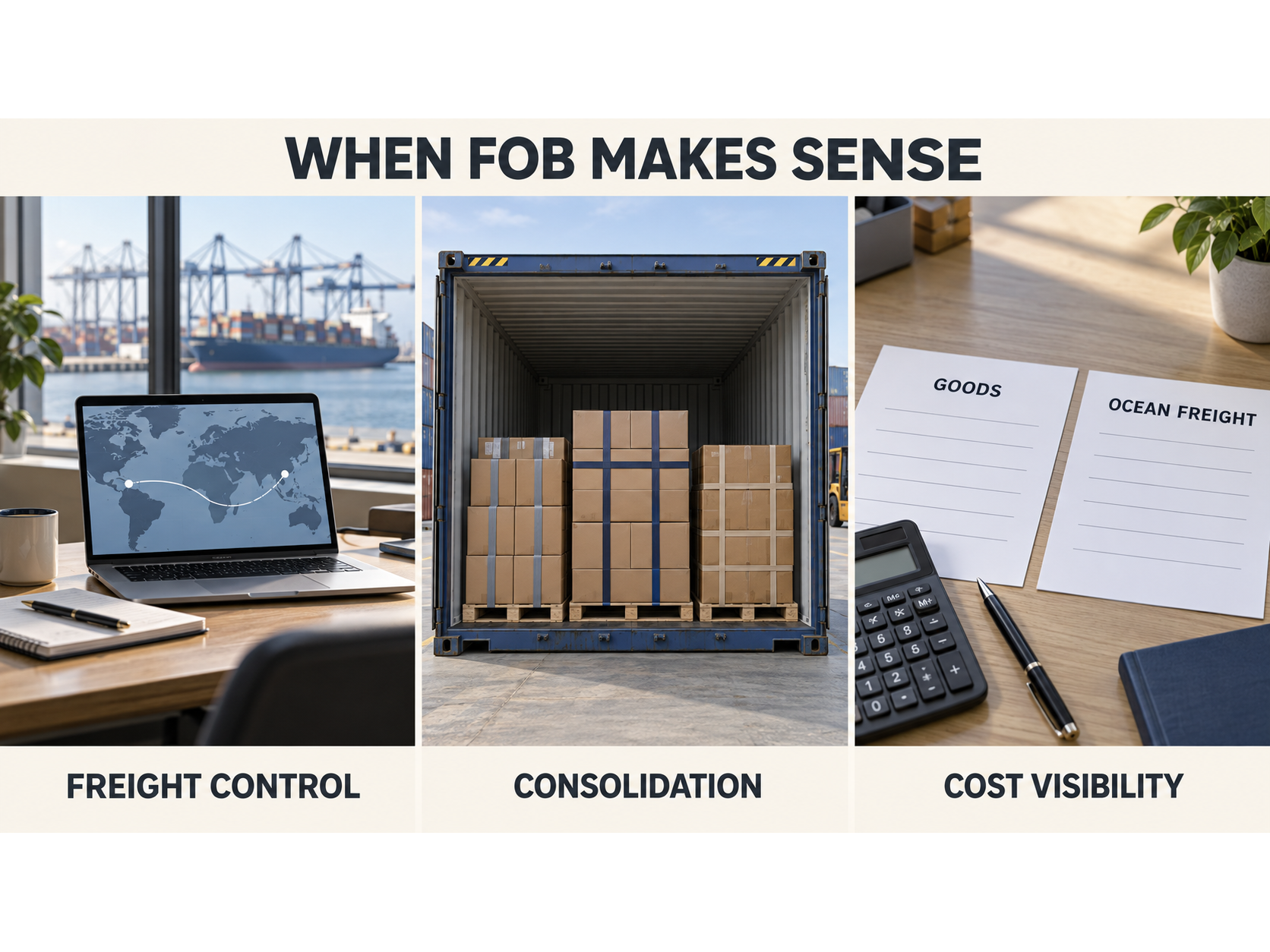
FOB gives you control of the main carriage, which matters if you have a freight contract better than your supplier's, if you are consolidating several suppliers into one container, or if you want to see what ocean freight actually costs instead of having it buried in a delivered price. Buyers with volume usually want FOB for exactly those reasons. The mistake is not using FOB. It is using the FOB number as if it were the cost.
What Should a Landed Cost Calculation Include?
Landed cost is the total cost of getting goods to a location you define. The definition is only useful once you fix the endpoint, so for this article the endpoint is usable inventory received at your U.S. warehouse or 3PL.
A practical model is:
Landed cost = FOB goods value + international freight + cargo insurance + duty and tariffs + government user fees + customs and filing fees + port and terminal charges + drayage + domestic delivery + directly attributable compliance and quality costs
Depending on the shipment, the model may also carry inspection, testing, relabeling, repacking, currency conversion and other handling. Not every line applies to every shipment, and a model that forces all of them in is as wrong as one that leaves them out.
Keep operational landed cost separate from accounting policy. Finance decides which costs are capitalized into inventory and which are expensed or tracked as risk allowances. A sourcing calculator cannot make that accounting determination.
Worked Example: From $2.00 FOB to $2.70 Landed
Consider an illustrative 10,000-unit CPG order. These figures demonstrate the method; they are not freight quotes or tariff advice.
Cost component | Illustrative amount | Basis |
|---|---|---|
FOB goods value | $20,000.00 | 10,000 units × $2.00 |
International freight | $2,400.00 | Example quotation |
Cargo insurance | $100.00 | Example premium |
Import duty | $2,000.00 | Illustrative 10% × $20,000 customs value |
Merchandise Processing Fee | $69.28 | 0.3464% × $20,000 |
Harbor Maintenance Fee | $25.00 | 0.125% × $20,000 |
Broker and filing fees | $350.00 | Example quotation |
Port, terminal, and drayage | $1,200.00 | Example quotation |
Domestic delivery | $600.00 | Example quotation |
Inspection/testing allowance | $300.00 | Planning assumption |
Estimated landed cost | $27,044.28 | $2.70 per unit, rounded |
Three of those lines are unfamiliar to most first-time importers. The customs broker is the licensed party who files your entry with CBP, and you pay them per entry whether the shipment is large or small. Port and terminal charges are what the facility bills for handling the container. Drayage is the short truck move from the port to your warehouse, short in distance, expensive per mile, and almost always underestimated. Together those three lines are $1,550 on this order, about $0.16 a unit, and none of them appear anywhere in an FOB quote.
The FOB price is $2.00. The warehouse cost is $2.70. That is 35% on top of the number in the quote, and it lands entirely on the buyer's side of the contract. At a 3x retail multiple it moves the shelf price by more than two dollars.
The fee rates above reflect current CBP guidance. For fiscal year 2026, CBP lists the formal-entry Merchandise Processing Fee (MPF) at 0.3464% of merchandise value, with a $33.58 minimum and a $651.50 maximum. The Harbor Maintenance Fee (HMF) is 0.125% for commercial cargo moved by vessel through identified ports. Exemptions and shipment facts can change what applies.
The MPF maximum is worth noting. Because the fee caps at $651.50 per entry, it is a real percentage on a small order and close to irrelevant on a large one.
The 10% duty above is hypothetical. Actual duty depends on classification, customs value, origin, preference eligibility, and any additional measures in effect on the entry date. Classification means the Harmonized Tariff Schedule, the code list that determines your rate, and it is revised through the year. Check the current revision rather than a saved PDF.

Do Not Calculate Duty from the FOB Quote Automatically
An FOB commercial price may resemble the starting value for customs purposes, but the two are not always identical. CBP explains that duty is generally assessed on the price paid for the goods, excluding freight and insurance, unless another basis such as quantity or volume applies. The declared value may require additions such as selling commissions, assists, royalties, production costs, packing, or proceeds.
This catches packaging buyers more often than most. If you paid for a die, a mold, a printing plate or a cylinder and the factory is using it to make your goods, U.S. Customs calls that an assist: something you supplied to the production for free or below cost. Its value can be dutiable even though it never appears on the supplier's invoice. The same goes for artwork you commissioned and handed over.
The cost model is only as good as the classification behind it. Confirm the HTS classification, origin, valuation treatment and applicable programs before you build it. If the treatment is uncertain and financially material, get a qualified customs professional involved and consider whether a CBP ruling is worth requesting.
Allocate Landed Cost at SKU Level
A flat percentage on top of every FOB unit is the most common way to get this wrong. It works out on average and is wrong on every individual SKU, which means the light one subsidizes the heavy one and you cannot see which products are actually making money. Use the cost driver that caused each expense:
Cost | Better allocation basis |
|---|---|
Duty and tariffs | Item-level customs value, HTS classification, and origin |
Ocean or air freight | Weight, cube, pallet position, or carrier-rated basis |
Brokerage and fixed filing fees | Entry line, shipment, purchase order, or unit—as documented |
Port, terminal, and drayage | Container, pallet, shipment, or actual charge driver |
Inspection and testing | Lot, SKU, sample plan, or purchase order |
Domestic delivery | Pallet, weight, cube, stop, or carrier-rated basis |
Estimate the landed cost before you issue the PO, then reconcile it against the actual broker, carrier and service invoices after receipt. Track the variance by cause: rate, volume, classification, delay, inspection, damage. The point is not the accuracy of any single estimate. It is that the third one is better than the first.
CPG Costs That Generic Calculators Miss
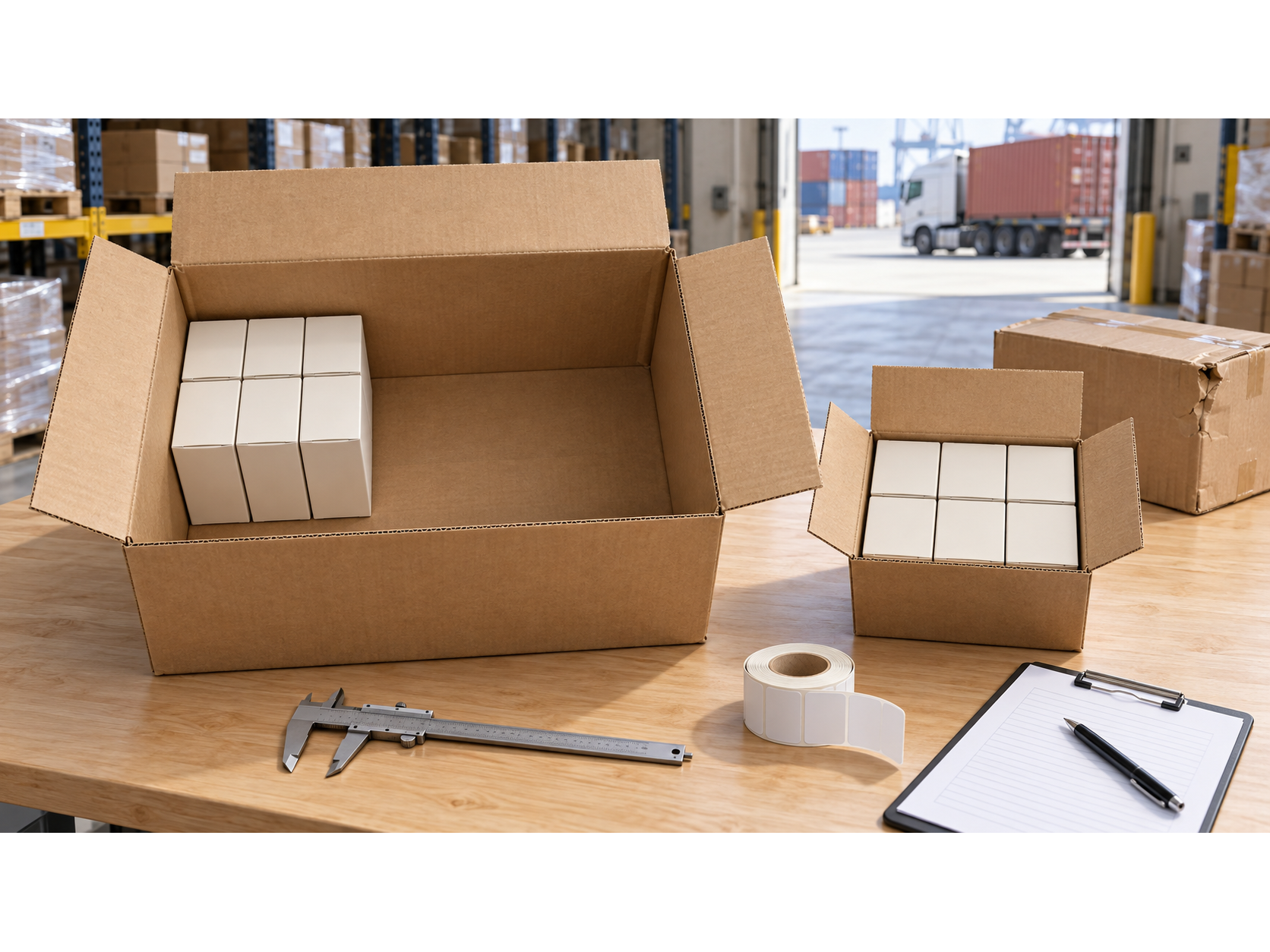
The lowest FOB offer becomes the expensive one when packaging cube, minimum order quantity, damage, rework or compliance effort differ between suppliers. Packaging cube is the one that surprises people: freight is billed on the greater of weight or volume, so a package that ships half empty pays for the air.
Packaging validation and pre-shipment quality inspection
Relabeling or repacking required for U.S. sale
Product testing and category-specific documentation
Damage, spoilage, and shelf-life erosion during transit
Demurrage and detention, the daily fees that start when your container sits at the port too long or your empty goes back late, plus storage and expedited transport when something slips
Cash tied up during production and transit, which on a 60-day lead time is 60 days of working capital sitting in a container
For vessel cargo, filing readiness matters too. The Importer Security Filing (ISF) is a data set U.S. Customs requires before your container is loaded, generally no later than 24 hours before loading.
Food products require an additional compliance workstream. FDA states that food importers are responsible for ensuring products are safe, sanitary, and labeled to U.S. requirements; facility registration, prior notice, inspection, and possible detention can also be relevant. Importers covered by the Foreign Supplier Verification Program (FSVP) have to build and run a verification program for each foreign supplier. These are planned before purchase or they arrive as a surprise at the port.
One number, one destination, every quote
Ask every supplier for the same thing: named place or port, Incoterms edition, what is included, what is excluded, currency, how long the quote is valid, and the packaging configuration. Without the packaging configuration, you cannot compare freight, and freight is where the quotes diverge.
Then pick the landed-cost endpoint and one allocation policy, and hold every supplier to it. FOB is a necessary contract term. It is not a number you can make a decision with.
Why we quote landed
Every price on Dylign is a landed price: materials, printing, finishing and delivery to your address, with taxes and duties identified separately before you order. That is a deliberate choice, and it costs us the ability to show a lower headline number than a factory quoting FOB.
The reason is the one this article is about. An FOB number cannot be compared to another FOB number without both breakdowns in front of you, and most buyers do not have time to build two of those to compare two pouches.